
RESORT BUYERS
For resort shoppers who want to distinguish a relevant firsthand account from a claim that does not support a booking decision.
If you are searching for Travel Elite Pass reviews before considering an all-inclusive resort in Mexico or the Caribbean, separate two decisions: whether to investigate an option and whether to pay for it. A review may justify the first without supplying enough evidence for the second.
We are a membership travel platform with member-only rates, an Exclusive Resort Collection, and an AI Deal Finder. Those capabilities describe what you can use; they do not establish a customer satisfaction score. Your task is to connect each review claim to a specific transaction, a relevant outcome, and the resort option you are considering.
Does the review identify the correct business?
Start with the exact name, Travel Elite Pass, and the domain travelelitepass.com. A review about a similarly named travel company cannot establish anything about your potential reservation here, regardless of how detailed or enthusiastic it is.
Searches for shortened phrases such as elite pass or travel pass can lose that distinction. Before weighing an account, look for a business profile, booking website, or transaction detail that connects it to the correct platform.
A title that includes the name is still insufficient on its own. The underlying account should actually concern the business, rather than an unrelated hotel loyalty program, a different agency, or general travel advice.
Identity and customer experience are separate forms of evidence. We are backed by The Chicago Hotel Collection, and bookings are processed through our platform's own checkout. Those facts help explain the business and transaction structure; they do not prove that an individual traveler received a particular rate or refund.
For that separate background question, read how Travel Elite Pass works. Keep this distinction intact as you read reviews: evidence about who operates a platform is not evidence about how a particular reservation went.
Which review details deserve the most weight?
A firsthand account has a clear relationship between the person writing it, the purchase, and the outcome. Useful details include what was booked, approximately when it happened, what the traveler expected, and what actually occurred.
Detail improves an account's usefulness, but does not automatically authenticate it. A receipt or screenshot can support a specific statement, while leaving other parts of the story unverified.
Read each type of material for the question it can answer. Promotional content can introduce a capability; a transaction account can describe an experience; booking terms can establish the conditions attached to an offer. Treating them as interchangeable creates false confidence.
Prefer a sequence of events over a strong adjective
An account that explains the reservation, a change request, and the eventual result gives you more to evaluate than praise such as excellent or criticism such as terrible. You can identify the issue and decide whether it matters for your trip.
Public reviewers do not need to disclose private booking references or payment information to be useful. Look for coherent, relevant details without expecting someone to publish sensitive documents.
| Material | Useful evidence | Limit |
|---|---|---|
| Firsthand booking account | What someone purchased and what happened afterward | One transaction does not establish the experience of every traveler |
| Receipt or confirmation image | Specific recorded booking details | An image alone does not prove the stay occurred or a refund was completed |
| Star rating without explanation | The reviewer's expressed satisfaction | It does not explain the transaction or the cause of satisfaction |
| Promotional video | A capability or offer being promoted | It is not independent evidence of a customer outcome |
| Secondhand opinion | A concern worth investigating | It does not establish that the writer booked or experienced the issue |
Which part of the trip is the reviewer describing?
A resort vacation involves different experiences that should not be collapsed into one judgment. Finding a rate, completing a reservation, staying at the property, and requesting a change each answer a different buyer question.
We provide one search across hotels, flights, cars, and activities, with a focus on all-inclusive resorts in Mexico and the Caribbean. Member-only rates appear after login through Reveal Price. An account about searching those options is therefore relevant to shopping, but cannot by itself establish a completed stay.
A resort review is evidence about the property
Comments about food, beach conditions, room maintenance, or entertainment concern the resort experience. They can help you decide whether the property suits you, but they do not necessarily reveal how the booking platform handled payment or confirmation.
The connection becomes stronger when the account identifies a mismatch between what was reserved and what was delivered. Even then, distinguish a documented booking inclusion from an expectation the traveler formed elsewhere.
A booking review is evidence about a transaction
An account describing room selection, checkout, confirmation, or a reservation discrepancy is more directly relevant to the booking experience. Its value depends on whether it explains the expected details and the actual result.
A refund account needs additional context. Cancellation and refund terms vary by the supplying hotel or airline and are shown at checkout per booking, so another traveler's outcome cannot establish the terms of your reservation.

What would make a savings claim relevant to your booking?
A claim that someone found a cheaper resort stay is useful only if the comparison describes equivalent purchases. The same property name does not guarantee the same room, meal plan, occupancy, or cancellation rights.
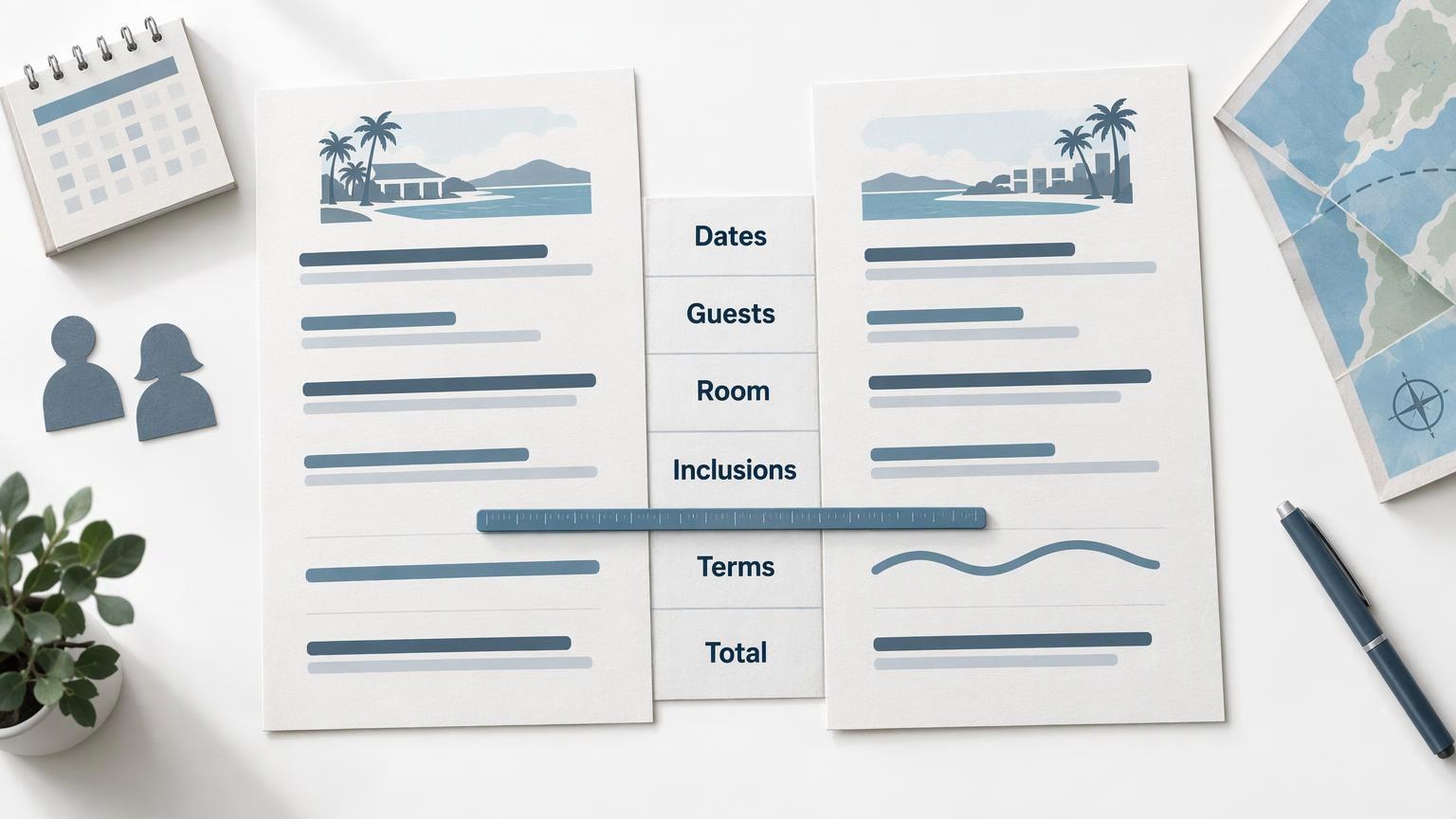
Compare the all-in total price for the same dates, guests, room category, and inclusions. Account for taxes, mandatory charges, and any separately payable amounts identified in the offer, rather than comparing a headline nightly rate with a complete trip total.
A screenshot showing a lower amount may accurately record what appeared at that moment. Without the room details and terms, however, it cannot establish that the lower offer was better value.
The downside of member-only pricing is that you need to log in to inspect the rate rather than judging the offer from a public headline alone. Access to a member rate also does not mean every option will beat every alternative.
Separate price differences from product differences
Say one account celebrates a lower price but compares a nonrefundable room with a flexible reservation. The difference may be meaningful for a traveler with firm plans, yet unattractive if your dates could change.
Likewise, a room-only price does not test the value of an all-inclusive offer. A comparison needs the actual meal plan and other included services, not assumptions based on the resort's name.
Treat AI praise as a discovery claim
We have an AI Deal Finder. A review saying it helped someone find an option describes discovery unless it also explains the purchase and outcome.
It does not prove that an AI-selected result was the lowest available price or the right resort for you. Judge the resulting offer on its details, just as you would an option found through an ordinary search.
How should you interpret a complaint without dismissing it?
Take a complaint seriously enough to identify its specific allegation. Then distinguish a reported problem from a conclusion about the whole platform.
A useful complaint explains what the traveler purchased, which promise or term they believe was not met, and what happened after they raised the issue. A clear timeline is especially helpful when the account concerns cancellation, a changed reservation, or money returned.
For a fee complaint, compare the amount paid with the total and payable charges disclosed for that booking. A charge appearing later deserves investigation, but the account needs enough context to distinguish an undisclosed mandatory charge from an optional purchase or a charge disclosed before payment.
The guide to hotel fees travelers can overlook provides useful vocabulary for identifying the charge involved. It is supporting context, not evidence that a particular complaint is accurate or inaccurate.
For a refund complaint, the decisive distinction may be between permission to cancel, eligibility for a refund, and completion of that refund. An account that only says the reservation was canceled leaves the financial outcome unclear.
Look for independent accounts describing the same specific issue, while recognizing that reposts of one story do not create additional experiences. Positive accounts deserve the same scrutiny: enthusiasm without transaction details should not outweigh a well-documented concern.
What does enough evidence look like for your trip?
Say you are considering an all-inclusive stay in Cabo and your travel dates may change. You encounter an enthusiastic search video, a detailed completed-stay account, and a complaint about a canceled reservation.
The video may help you understand how someone found an option, but it contributes little to your concern about flexibility. The completed-stay account is useful if it connects the reserved room and inclusions to what the traveler received.
The cancellation complaint is potentially the most relevant account for your situation. Its usefulness depends on whether it identifies the booked terms, the timing of the request, and the refund outcome.
If it lacks those details, neither accepting nor dismissing it is justified. The practical conclusion is to inspect a flexible offer rather than assume that another person's cancellation experience predicts yours.
If the current option is nonrefundable and your dates remain uncertain, a positive completed-stay review does not fix that mismatch. A reservation through another route with terms that better suit your plans may be the better choice, even if its initial price is higher.
If your dates are firm, the room and inclusions match your needs, and the relevant accounts describe coherent completed transactions, continuing your comparison can be reasonable. That is permission to investigate an offer, not a guarantee about a future trip.
Compare review claims with the resort offering before paying
Use the resort offering as a reference point for what is being sold, and reviews as evidence about reported experiences. Neither replaces the other.
Our Exclusive Resort Collection and focus on all-inclusive resorts in Mexico and the Caribbean make exploring the offering a relevant next step. You can compare the options with the specific resort, room, and inclusions described in a firsthand account.
Start with trip fit before interpreting broad claims about value. A review of a different room category or meal plan may not address the vacation you want. The selected booking's details determine the room, inclusions, total price, and cancellation terms that would apply to you.
A reviewer's member-rate screenshot is a record of a past offer, not a quote for your trip. Use the current offer for your dates and guests as the comparison point. Member-only positioning is not a customer rating, proof of savings, or evidence that a resort endorses the platform.
As you compare, keep the claim attached to its evidence. A firsthand account can inform your confidence in a reported transaction; the current offer tells you what you would purchase now. Compare equivalent rooms, inclusions, and terms using the all-in total price.
Visit Travel Elite Pass to explore the all-inclusive offering. Compare it with relevant review claims to decide whether the accounts address the experience you actually need and provide enough evidence to continue considering a booking.
Frequently Asked Questions
Is a verified-purchase badge enough to trust a review?
No, a verified-purchase badge should not replace reading the account itself. Examine what the review service explains about that label, then assess whether the writer describes the outcome you care about. Evidence of a purchase can strengthen the connection to a transaction without establishing that every statement is accurate or that the experience applies to your booking.
Which travel review site should I use?
Use a review service that identifies the correct business and explains its review labels and moderation practices. For a resort decision, keep property reviews separate from booking-platform reviews, because they cover different experiences. Compare the detail and relevance of the accounts rather than choosing a service solely because it displays a prominent star score.
How recent should a review be?
Prefer accounts with a clear transaction date that are relevant to the current offering, rather than applying an arbitrary age cutoff. An older completed stay may still explain a specific experience, but cannot establish today's availability, price, or booking terms. A recently posted review may also describe an older trip, so distinguish the posting date from the transaction date.
Can reviews tell me how much membership costs?
Reviews should not establish the current membership cost or enrollment conditions. Another person's account may describe an earlier offer or leave out conditions that matter to you. Read the current account-creation terms before enrolling, and assess any membership cost separately from the total price and terms of the resort reservation you are considering.
How can I verify my own hotel reservation after booking?
Use your confirmation details to contact the property through an independently verified contact channel and ask it to match the reservation. Compare the guest name, stay dates, room category, and meal plan, while protecting payment information. If details do not match, retain the documents and raise the discrepancy through the booking channel identified in your reservation.
Should I pause if I cannot find detailed firsthand accounts?
Pause if firsthand evidence is necessary for your confidence and the accounts you find do not answer your concern. Limited detail is not proof of either reliability or misconduct. You can continue researching the offering without paying, or choose a booking route whose terms and available evidence better meet your needs, especially for a costly or inflexible reservation.