
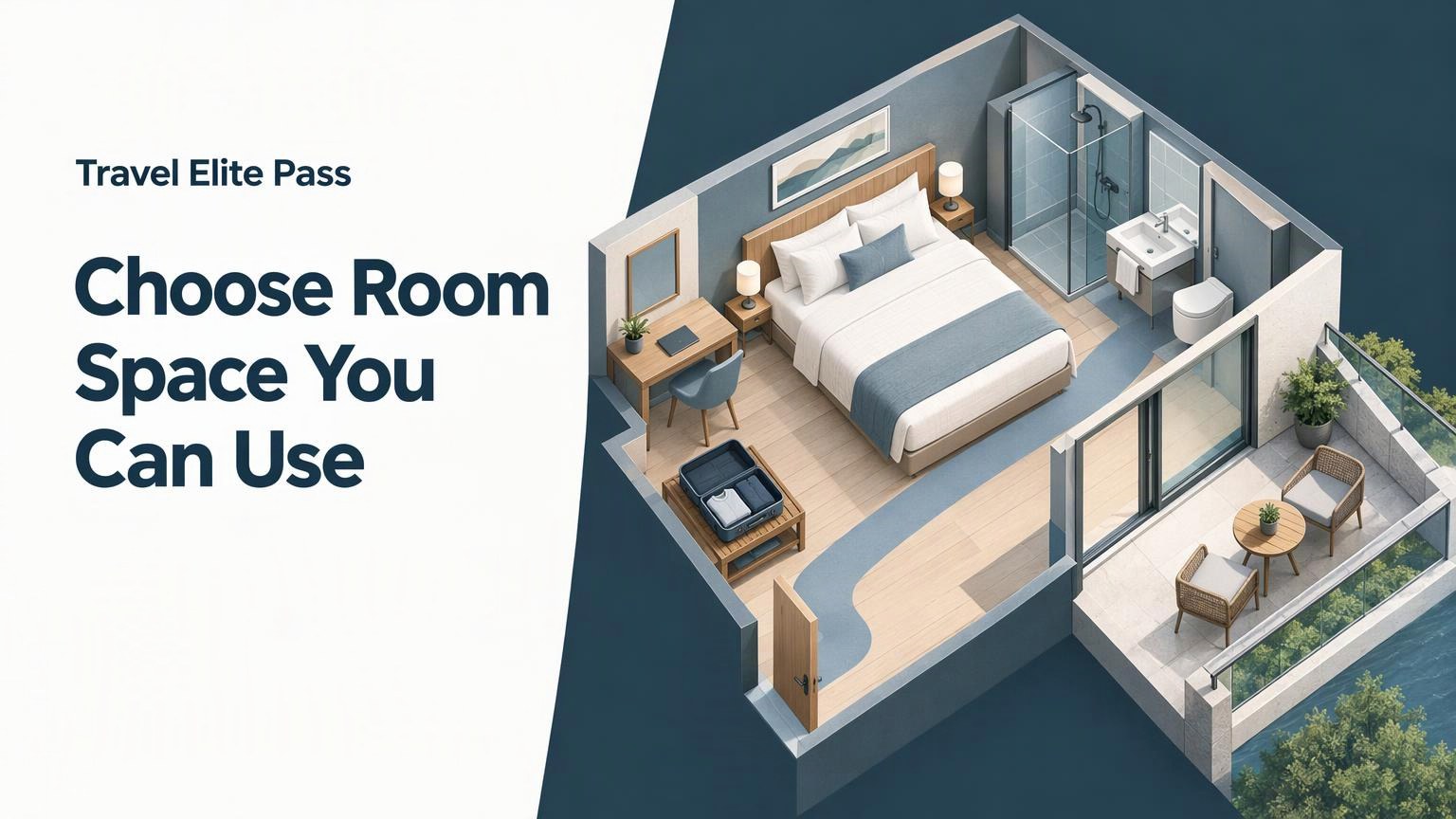
SPACE-CONSCIOUS TRAVELERS
For travelers comparing resort rooms, learn how to judge the indoor space available for unpacking and moving around.
A resort room can look like a spacious alternative to a motel until you try to unpack. The balcony may account for part of the advertised area, while a generous bathroom or a fixed seating arrangement leaves less space beside the bed than you expected.
The useful comparison is the room category you would actually book, with its furniture in place. Separate outdoor space from indoor space, trace your walking routes, and decide where your bags will live. That gives you a better basis for choosing than a room name, a wide-angle photo or a larger headline measurement.
What does the advertised room area actually include?
Before comparing measurements, establish what each measurement describes. An indoor room area and a combined indoor-and-terrace area are different things, even if both appear beside the same room-size label.
If the description does not explain the measurement, leave its meaning open rather than assuming the larger number means more room to unpack. You need comparable information before the figures can help you choose.
Separate outdoor space from your indoor needs
A balcony or terrace can be valuable for sitting outside. It does not solve an indoor storage problem if you want your clothes and luggage kept inside.
Look for separate indoor and outdoor measurements where they are available. If a combined figure is all you have, use the layout to assess the interior and ask the property whether the outdoor area is included before treating that figure as a room-space advantage.
Distinguish enclosed area from free floor
Indoor area still includes space devoted to other purposes. A bathroom helps you get ready, but its floor is not automatically a suitable place to leave a suitcase.
Likewise, beds, built-in cabinets and fixed seating occupy part of the interior. Think of total area as the boundary of the room, then use the furnished layout to decide how much of that area supports movement and unpacking.
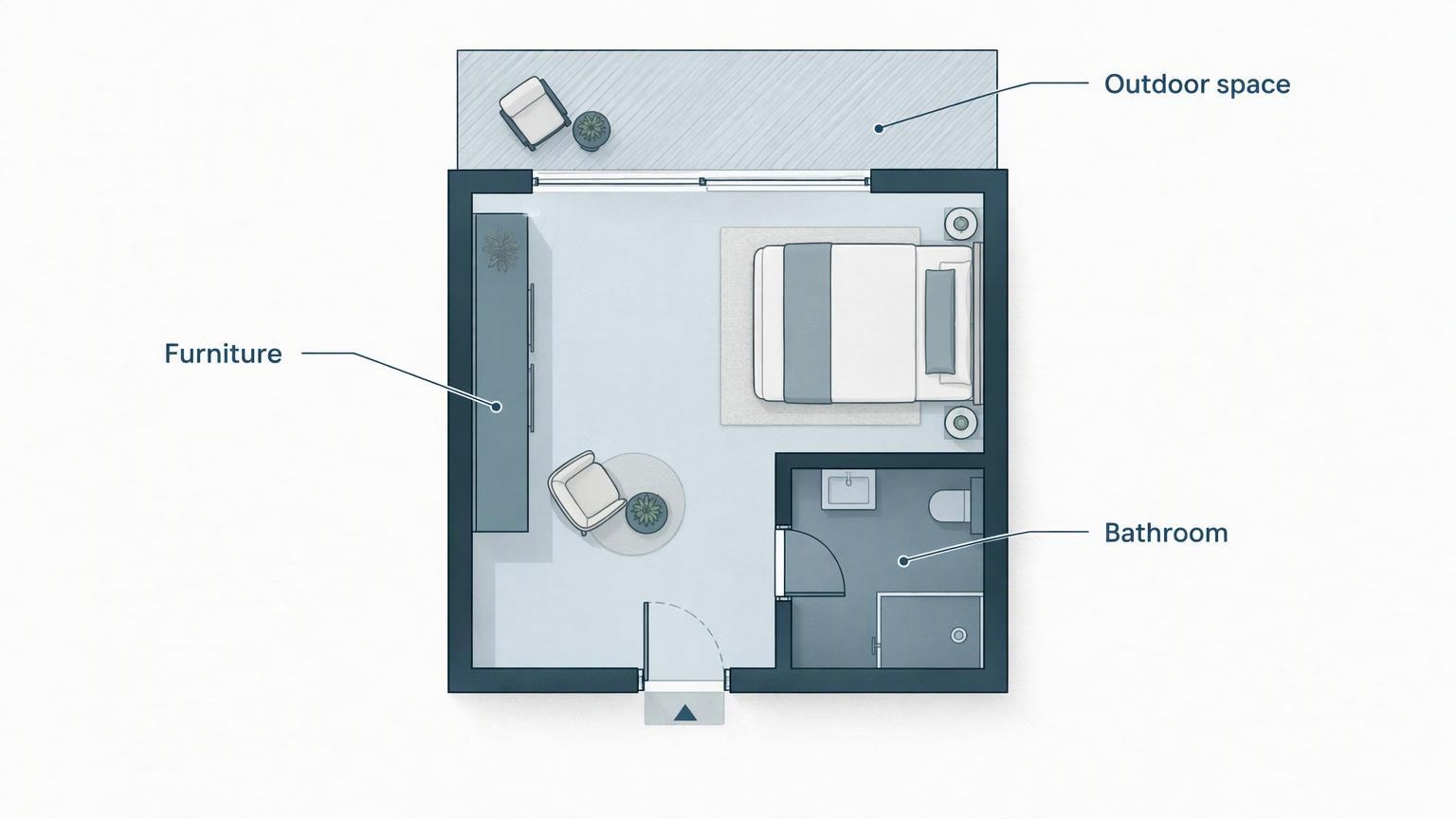
How do you read a furnished room layout?
Start at the entrance and trace a route to the bed, bathroom and luggage-storage position. A room is workable when those routes remain usable during the activities you expect to do, not merely when everything is closed and put away.
Look for pinch points beside the bed, between a cabinet and a wall, or around the end of a sofa. A long strip of empty floor may contribute to the total area without giving you a useful place to open a bag.
Room shape matters here. Space divided into narrow passages is not interchangeable with an open patch beside a wardrobe, even when the total measurements match.
Check doors, drawers and access
A suitcase position is less useful if it prevents a closet door from opening. Where a plan shows door swings, consider them alongside the furniture; where it does not, use category-specific photos to understand how storage opens.
Check whether you can reach both sides of the bed if that matters to you. Also distinguish the presence of a desk or chair from the space needed to pull the chair out and actually use it.
Use photos for arrangement, not exact dimensions
Photos can show whether a cabinet is built in, whether the bed sits against a wall and where a luggage bench is positioned. They are less dependable for judging precise clearance without measurements.
Use several views of the exact room category rather than relying on a single attractive angle. A photograph of a different suite or an outdoor seating area does not establish the layout of the room you are selecting.
Where will your luggage go after you arrive?
Choose your unpacking method before deciding how much floor space you need. If you transfer clothes into drawers and store your case closed, your needs differ from someone who keeps a suitcase open throughout the stay.
Measure your own luggage in the position you use it. A case that opens flat needs a different footprint from a bag accessed from the top, so the closed-case dimensions alone may not answer your question.
Then match that footprint to a place in the room. A clear storage position is stronger evidence of usability than an unspecified amount of extra area.
- If you unpack fully, look for storage for your belongings and a separate place for the empty case.
- If you live out of your bag, identify a surface or floor position where it can remain open.
- If you bring a stroller or bulky equipment, give it a storage position that does not occupy the main walking route.
- If you need the desk for work, do not count it as your permanent luggage surface.
A luggage rack is useful only if it suits your bag and fits where you need it. Its presence does not establish that all your luggage will have a home.
Keep the exit and access routes clear in your plan. A room that works only when a case is left across the doorway is not a workable choice for your packing style.
Test the room with its sleeping furniture in use
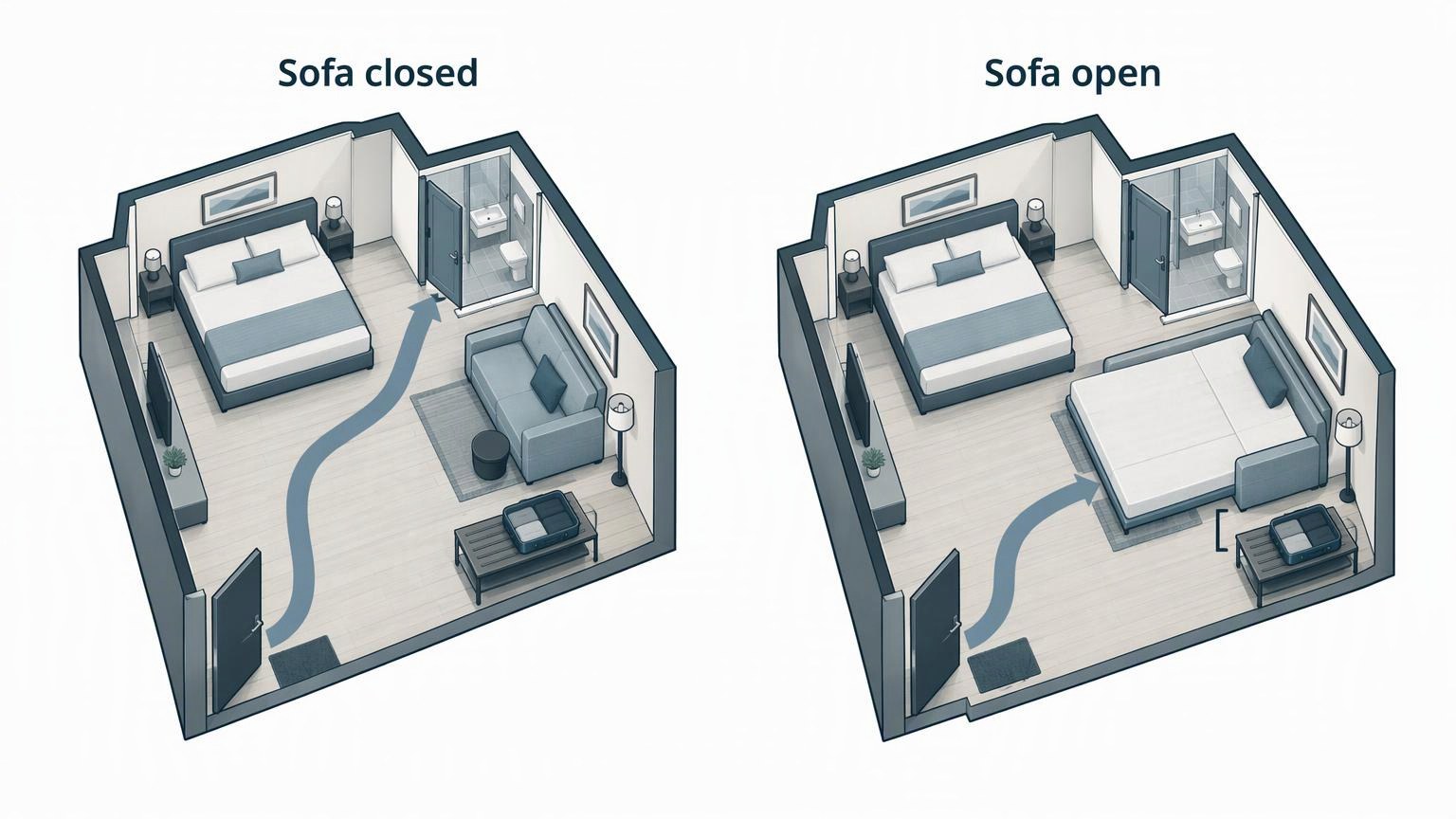
The daytime layout may hide the room's most demanding arrangement. A sofa used for seating occupies a different footprint when opened as a bed, and a rollaway needs a placement of its own.
Hotels may use rollaways or pullout sofas as additional sleeping options. For your comparison, the important question is where that sleeping surface goes and which route or luggage position it affects.
The configurations below are choices to evaluate, not guarantees about any property. Select by the actual bedding and furnished layout, rather than assuming a room label establishes either.
Keep occupancy separate from comfort
Permission to accommodate your party and enough space for your belongings are separate tests. Enter every traveler accurately and follow the occupancy terms for the exact category.
Do not assume that room area creates permission for another guest, or that permitted occupancy proves comfortable luggage clearance. A room must meet the booking requirements and your practical needs.
| Configuration | Space implication | Most useful when | Detail to establish |
|---|---|---|---|
| Room with fixed beds only | Bed positions stay the same during the day and night | You want a predictable luggage position | Clearance around beds and access to storage |
| Room with a sofa bed | Opening the bed changes the available floor space | You need an additional sleeping surface | Open-bed position and remaining walking routes |
| Room using a rollaway | An extra bed needs its own placement | The property permits this arrangement for your party | Availability, placement and any applicable charge |
| Room with a separate living area | Activities can occupy different parts of the accommodation | You need separation between sleeping and unpacking | Whether the living area remains usable with all beds deployed |
A larger advertised room can still be the wrong choice
Say you are considering a resort instead of a motel and prefer to keep your suitcase open while you stay. You also want to use the desk without clearing your belongings each morning.
One option has the larger headline area, a terrace and fixed seating beside the bed. Another has a smaller advertised area, but its category-specific layout shows an indoor luggage bench away from the desk and the bathroom route.
First, establish whether the terrace is part of the larger figure. Then compare the indoor arrangements: does the fixed seating leave a usable bag position, or would your open case occupy the only clear path?
If the bench fits your luggage and leaves the desk available, the smaller option better matches your daily routine. The larger option may be preferable if you unpack into storage and value the terrace more than an open-case position.
The choice follows from how you use the room. You are comparing a dedicated indoor function with an outdoor benefit, rather than treating all additional area as equally useful.
If neither layout shows enough detail to establish luggage placement, neither deserves a confident space ranking yet. Obtain that specific detail before paying more for an apparent size advantage.
When is a room upgrade worth paying for?
An upgrade is useful when it solves a problem you will encounter during the stay. More indoor clearance, a suitable luggage bench or separation between sleeping and working can matter more than an impressive category name.
Identify what changes between the actual categories. If the difference is mainly a view or outdoor area, treat it as that kind of benefit rather than paying for it under the assumption that you are buying more unpacking space.
Consider how often you will use the improvement. Keeping a desk free every day is a different benefit from having a place to open a suitcase briefly on arrival.
There is a downside to choosing purely for space: you may pay for an area you rarely use. A larger bathroom or a separate lounge can be worthwhile, but neither automatically improves the clearance around your luggage.
Once both options meet your practical needs, compare their all-in trip prices and booking terms. Keep meal plans and other inclusions aligned where possible so the room-space decision does not get mixed up with a different package benefit.
For the wider reservation process, use the steps for booking an all-inclusive resort after identifying the room layouts that work. A good room choice still needs a suitable rate and acceptable cancellation terms.
Compare resort room options before selecting accommodation
For a Cabo stay, explore resort options through the Travel Elite Pass website. Compare any available category-specific room measurements or layouts before selecting accommodation, keeping indoor luggage space and clear walking routes at the center of your decision.
At Travel Elite Pass, we provide member-only rates, an Exclusive Resort Collection and one search across hotels, flights, cars and activities. Our focus on all-inclusive stays in Mexico and the Caribbean makes resort accommodation a relevant alternative to explore.
The room layout and the member rate answer different questions. Establish which options provide usable indoor space first, then log in to reveal pricing and compare the total trip cost for those options.
Do not infer room dimensions, bedding guarantees or availability from a collection listing alone; carry the exact category through to your booking review. If a missing layout detail determines whether your luggage fits, resolve it before selecting that room.
We process bookings through our platform's checkout. Cancellation and refund terms vary by the supplying hotel or airline and are shown at checkout for each booking, so review them before committing.
Frequently Asked Questions
Is 269 square feet small for a hotel room?
The figure alone does not establish whether the room will feel small for your needs. Check what the measurement includes, the furniture arrangement and where your luggage will go. Someone who unpacks into storage may find a layout workable that does not suit someone who keeps a suitcase open beside the bed.
Is there a standard hotel room size in square meters?
There is no single room-size figure you should use as a universal booking standard. Compare the exact categories under consideration using the same units and measurement basis. Your practical test is whether the furnished indoor layout supports your belongings and movement, not whether it matches a general average.
Does a room called a suite guarantee a separate bedroom?
Do not treat the word suite as a guarantee of a separate bedroom. Look for an explicit layout showing the sleeping and living areas, including whether a door separates them. For unpacking space, also establish whether the living area remains available when any sofa bed or additional sleeping furniture is in use.
Can I request furniture removal to create more space?
You can ask, but do not select a room on the assumption that furniture will be removed. Built-in items cannot be treated as movable, and other changes depend on the property. Choose a layout that works as furnished unless the property explicitly confirms an acceptable arrangement before you commit.
Should I choose an entire rental if indoor space is my only priority?
An entire rental is worth comparing if its layout fits your indoor-space needs better than the available resort rooms. Distinguish an entire-property rental from a room within a home, since those are different accommodation choices. Evaluate the actual interior and total price rather than assuming the accommodation category guarantees more usable space.
When should I resolve a missing room-layout detail?
Resolve a detail before booking when it determines whether the room will work for you. Ask a specific question, such as whether an open sofa bed blocks the luggage bench or whether the stated area includes the terrace. If you reserve before receiving an answer, review the cancellation terms rather than assuming you can change freely.