

FRIENDS AND FAMILY TRAVEL
For friends and families with different spending limits, choose shared essentials first and leave room for genuinely optional upgrades.
A mixed-budget vacation becomes harder when everyone agrees on a resort name but imagines a different stay. You may want a comfortable room and relaxed meals together, while someone else wants a premium suite and paid experiences.
A room upgrade can be harmless; an access upgrade that moves the group into a restricted dining area can change the whole arrangement.
Whose budget should set the resort shortlist?
The lowest agreed total-trip budget should determine which resorts stay on the shortlist. An average budget does not help the traveler who cannot afford their own share, even if the group average looks comfortable.
Ask each person to identify a comfortable maximum privately. The planner needs the spending ceiling and essential needs, not an explanation of anyone's finances. Agree that a maximum is a limit, rather than an invitation to spend every available dollar.
Separate the total-trip ceiling from the amount available for the resort. Someone with a more expensive departure flight may have less left for accommodation than someone with the same overall budget. The same resort rate can therefore be affordable for one traveler and out of reach for another.
Also establish who is paying for whom. A couple paying together, a parent covering children and a friend paying independently need different calculations. Compare actual payer responsibilities rather than dividing every expense equally by head count.
If someone wants to cover part of another person's cost, agree on that before expanding the shortlist. Make the amount and purpose clear, including what happens if plans change. A voluntary contribution can make a resort viable, but an assumed contribution should never be the reason everyone commits.
Can people book different room categories at the same resort?
Different room categories can work when the differences stay personal. More space or a preferred view may justify extra spending for one traveler without changing anyone else's experience.
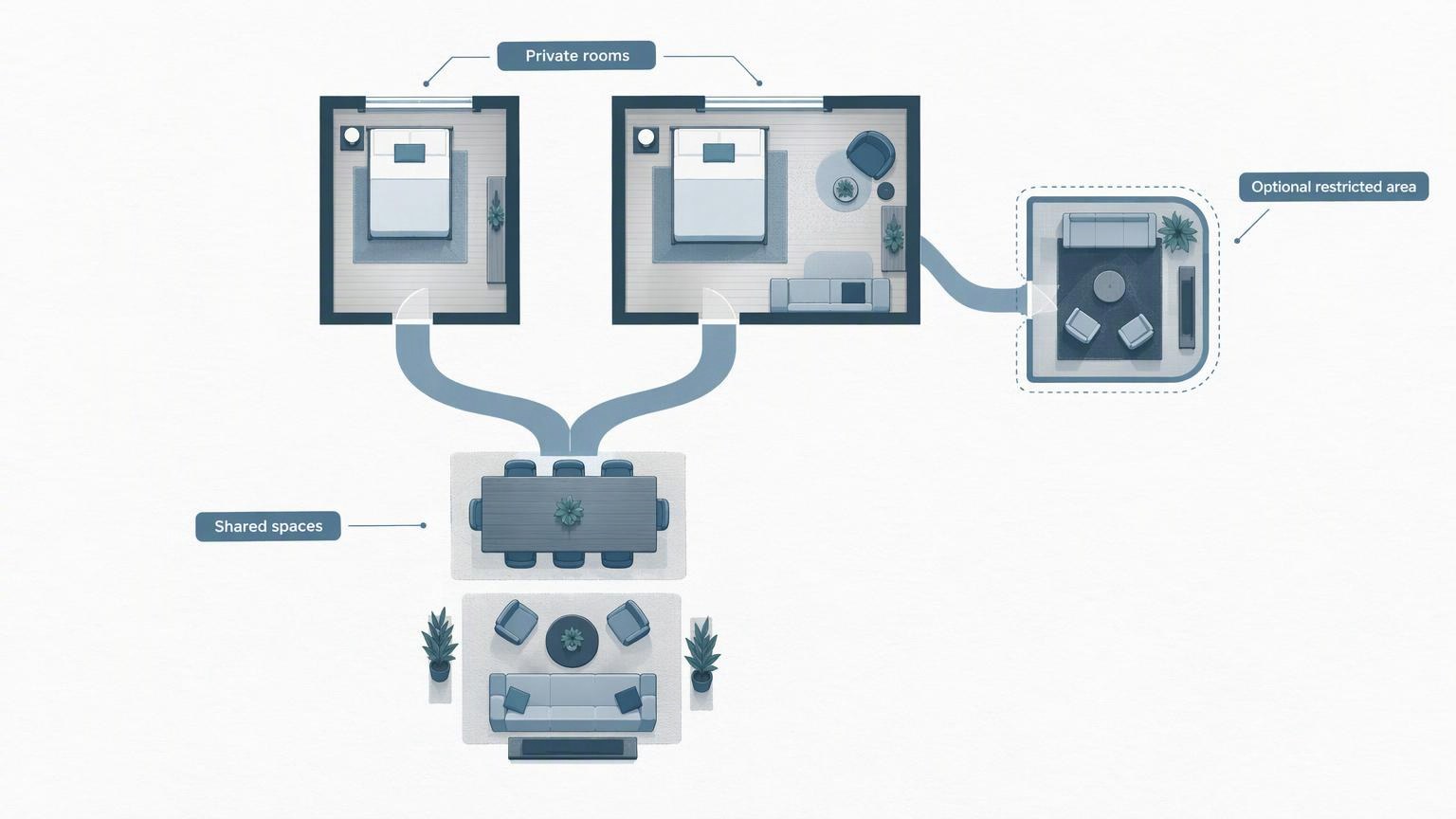
Access differences need closer attention. If an upgrade includes separate dining or recreation areas, decide whether upgraded travelers are happy spending the group's shared time in spaces everyone can enter. Do not assume that an upgraded guest can bring other travelers into restricted areas.
Evaluate the exact categories being considered, not just the resort's general description. The question is whether those bookings support compatible meals and gathering places. A category that changes the social plan is a different proposition from a category that changes only the bedroom.
| Arrangement | What stays shared | Main trade-off | Choose it when |
|---|---|---|---|
| Same room category | Room standard and documented access | Higher spenders give up room preferences | Everyone is satisfied with the affordable option |
| Different categories with compatible access | Meals and gathering spaces | Rooms differ, so expectations need to be clear | Upgrades improve private comfort without changing group plans |
| Different categories with restricted access | Only spaces included for every category | Premium areas may separate the group | Upgraded travelers accept that shared time happens in common spaces |
| Separate properties | Only independently arranged meetups | Shared time requires additional logistics | No single property meets both the budget and essential needs |
How do you compare the complete cost for each traveler?
Build a cost comparison for each payer using the same dates, guest details and booking assumptions. A resort-only figure cannot establish whether the complete trip fits someone's spending limit.
Include the selected accommodation total, transportation and any necessary purchases outside the booking. Add the cost of activities the group has already agreed are essential. Keep personal extras in a separate column so they cannot quietly become part of the minimum trip.
Compare taxes, mandatory charges and amounts payable later alongside the booking total. An amount collected at the property still counts against the traveler's budget. Record what is included, what requires another payment and who is responsible for each shared expense.
- Use the actual room occupancy and guest ages when requesting prices.
- Allocate shared room costs according to the agreement between the people paying.
- Include necessary airport transportation whether bundled or booked separately.
- Compare cancellation conditions alongside cost, rather than treating unlike bookings as equivalent.
Do not use a double-occupancy result to decide what a traveler staying alone will pay. Similarly, avoid assuming that changing a room assignment leaves every other person's cost unchanged. Reprice the affected arrangements before approving a change.
Leave room within each person's ceiling for expenses they expect but have not yet priced. The purpose is to avoid a booking that consumes the whole budget before essential trip costs are settled. If the affordable room only fits by leaving out necessary transportation, it does not fit.

A resort choice with different spending priorities
Say you are traveling with friends who want daily meals together and plenty of relaxed group time. One traveler has a firm spending ceiling; another is willing to pay more for a better room and a special dining experience.
Your first candidate has an affordable booking option whose documented inclusions cover suitable shared meals and common spaces. A higher-priced room changes private comfort without removing those shared options. Your second candidate only fits the lower budget in a category that excludes the area where the group expects to spend most evenings.
The first candidate is the better fit if its complete cost works for every payer. The higher spender can select the upgraded room, while everyone keeps the agreed meal plan. A paid dining experience can happen separately or become a shared event only after everyone accepts its cost.
The second candidate is not made affordable by the existence of a lower room price. Its cheaper category leaves someone outside the planned experience. You would need to change the evening plan, arrange an explicit contribution or remove that candidate.
Now add a traveler who plans to spend much of the stay on independently paid excursions. Their willingness to spend more should not raise everyone else's resort requirement. But if the whole group wants to join those outings, the outings belong in the shared cost calculation.
This distinction gives you a defensible choice: prioritize the property that supports the promised time together, then let individuals decide how much additional comfort or independent activity they want.
When is one all-inclusive resort the wrong fit?
One resort is the wrong fit when the affordable option cannot meet a genuine essential need, or when the group cannot agree on a shared daily plan. A booking below the spending ceiling is not enough if someone cannot comfortably participate.
Distinguish preferences from needs before abandoning the search. A premium view is different from a room requirement related to mobility. An optional dining upgrade is different from having suitable food available. Essential requirements belong in the selection criteria even when they narrow the options.
If no candidate works, change the trip structure. Shortening the shared stay can reduce the number of paid nights, although transportation and other costs still need comparison. Changing dates or destination is another search option, not a guarantee of a lower total.
Separate properties may suit travelers with incompatible expectations, but they give up easy shared meals and spontaneous gathering time. Do not assume guests can visit another resort without restrictions or charges. Planned meetups need their own access and transportation arrangements.
Also consider a non-inclusive stay if the group mainly wants a shared base while eating and exploring independently. The trade-off is that meals and activities require separate spending decisions. That arrangement may fit the itinerary better, but it still needs a complete cost comparison.
It is reasonable to choose a different trip rather than make the lowest-budget traveler repeatedly opt out. The goal is a visit everyone wants to join, not preserving the first resort someone suggested.
Compare the shortlist, then coordinate the booking
Once the group agrees on its spending ceiling and essential inclusions, search for stays that satisfy both. At Travel Elite Pass, we provide one search across hotels, flights, cars and activities, with an Exclusive Resort Collection and a focus on all-inclusive stays in Mexico and the Caribbean.
Our member-only rates appear after login through Reveal Price. Use the available rate as a comparison input alongside the exact room category, documented inclusions and complete trip cost. Member-only pricing does not establish that a booking is the lowest-priced option or that different room categories have identical access.
Start your all-inclusive destination comparison on Travel Elite Pass with the group's agreed requirements beside you.
Before anyone pays, circulate the selected dates, room arrangements, inclusions and payer totals. Give each person a chance to approve their own cost and terms. Multiple straightforward reservations can work well; the important issue is whether everyone understands what happens if another traveler changes plans.
Bookings are processed through our platform's checkout. Cancellation and refund terms vary by the supplying hotel or airline and appear at checkout for each booking. Save the applicable terms and booking details so the group has a shared record of what was purchased.
Frequently Asked Questions
How much should a mixed-budget group expect to spend?
There is no single useful group price without dates, departure points, room occupancy and guest details. Request current totals for the arrangements each payer will actually book, then add necessary costs outside the package. Keep optional purchases separate, and compare the all-in trip cost rather than relying on an advertised per-person figure.
When should everyone commit to booking?
Commit when each payer has approved the current total, selected room arrangement and applicable cancellation terms. Agree on a booking window rather than letting the first purchase force everyone else's decision. If a price or availability changes before the remaining travelers book, revisit the agreement instead of assuming they can absorb the difference.
What happens if a roommate cancels?
A roommate's cancellation may affect the remaining traveler's room cost or booking arrangement, depending on the applicable terms. Review those terms before payment and agree on how any additional expense would be handled. On Travel Elite Pass, cancellation and refund conditions vary by supplier and are shown at checkout for each booking.
Can children and adults be included in the same budget comparison?
Yes, but use the actual guest ages and room assignments rather than treating every traveler as an identical adult booking. Establish which adults are paying for the children and include the activities the family needs in the shared plan. Any age-based eligibility or pricing must come from the selected booking's current details.
How should dietary needs affect the choice?
Dietary needs should be part of the essential selection criteria, not left to optional restaurant upgrades. Establish whether the resort can accommodate the specific requirement in dining options accessible to the traveler's booking category. For allergies or medically necessary restrictions, obtain a direct explanation of available arrangements before committing; a general menu description is not enough.