

HEAT-SENSITIVE TRAVELERS
For travelers who need a cool bedroom to sleep, the room category and its operating rules matter more than a general air-conditioning label.
Your concern may be simple: you cannot sleep comfortably in a warm room. Finding the best resort in Costa Rica for that need requires a different comparison than choosing by beach photos, dining plans, or suite size.
Treat overnight cooling as a room-selection requirement, then compare the remaining choices on price and vacation style. This approach works whether you want an all-inclusive stay or another resort format. The aim is not to identify a universally cold hotel. It is to distinguish a room with documented, suitable cooling arrangements from one whose description leaves you relying on assumptions.
Define the cooling result you need
Start with the condition that makes the room usable for you. Wanting air conditioning is different from needing control over a particular overnight setting, and both are different from needing a separate bedroom cooled behind a closed door.
Write your essential requirement in ordinary language. For example: "I need bedroom air conditioning that I can adjust and leave available throughout the night with the bedroom door closed." If you have a personal temperature requirement, include it with the temperature scale rather than describing the room as "cold."
Separate essentials from preferences. Cooling during sleep might be essential, while having the room already cooled when you return from dinner might be a preference. That distinction lets you accept a workable operating rule without accepting a room that fails your main need.
A precise requirement also prevents an unnecessary upgrade. A larger suite is not a better cooling choice merely because it costs more; the relevant difference is whether its cooling arrangements suit the way you will use its sleeping spaces.
Decide whether a setting or an outcome matters
A selectable thermostat setting describes a control. It does not, by itself, establish that the bedroom will reach and maintain that temperature under every condition.
If selecting your preferred setting is enough, document the available control range. If maintaining a particular room temperature is essential, a statement about the thermostat alone does not settle your decision. Ask specifically about that outcome, and do not treat an unanswered performance question as a promise.
What does an air-conditioning description actually establish?
Read the description at the level where it appears. Air conditioning in a property's general amenity list is not the same evidence as air conditioning in the selected room category's details.
Likewise, "individually controlled" answers a narrower question than it may seem to. It indicates guest control, but does not tell you the available settings, whether a nighttime rule affects operation, or which spaces the equipment serves.
Use the wording to identify what is established, not to fill in everything you hope it means. Photos of a wall controller can support a question about the equipment, but they do not establish its permitted settings or prove that the photographed room matches your selection.
Do not use resort labels as cooling specifications
Luxury, all-inclusive, eco-focused, and beachfront describe other aspects of a stay. None answers your particular question about bedroom controls.
Natural ventilation and fans may suit someone who welcomes outside air. They are not equivalent evidence when your requirement is a bedroom with adjustable refrigerated cooling and closed windows. Choose between those room designs based on your sleep needs, rather than treating one as universally better.
| Description | What it addresses | What still needs room-specific detail |
|---|---|---|
| Air conditioning in property amenities | A general property amenity | Whether it applies to the selected room and sleeping areas |
| Air conditioning in room details | Equipment listed for that room category | Guest controls and overnight operating rules |
| Individually controlled air conditioning | Guest adjustment of room cooling | Available settings and any limits or automatic changes |
| Ceiling fan or natural ventilation | Air movement or a ventilation approach | Whether refrigerated air conditioning is also provided |
| Air-conditioned suite | Cooling described for the suite | Coverage of separate bedrooms and other sleeping spaces |
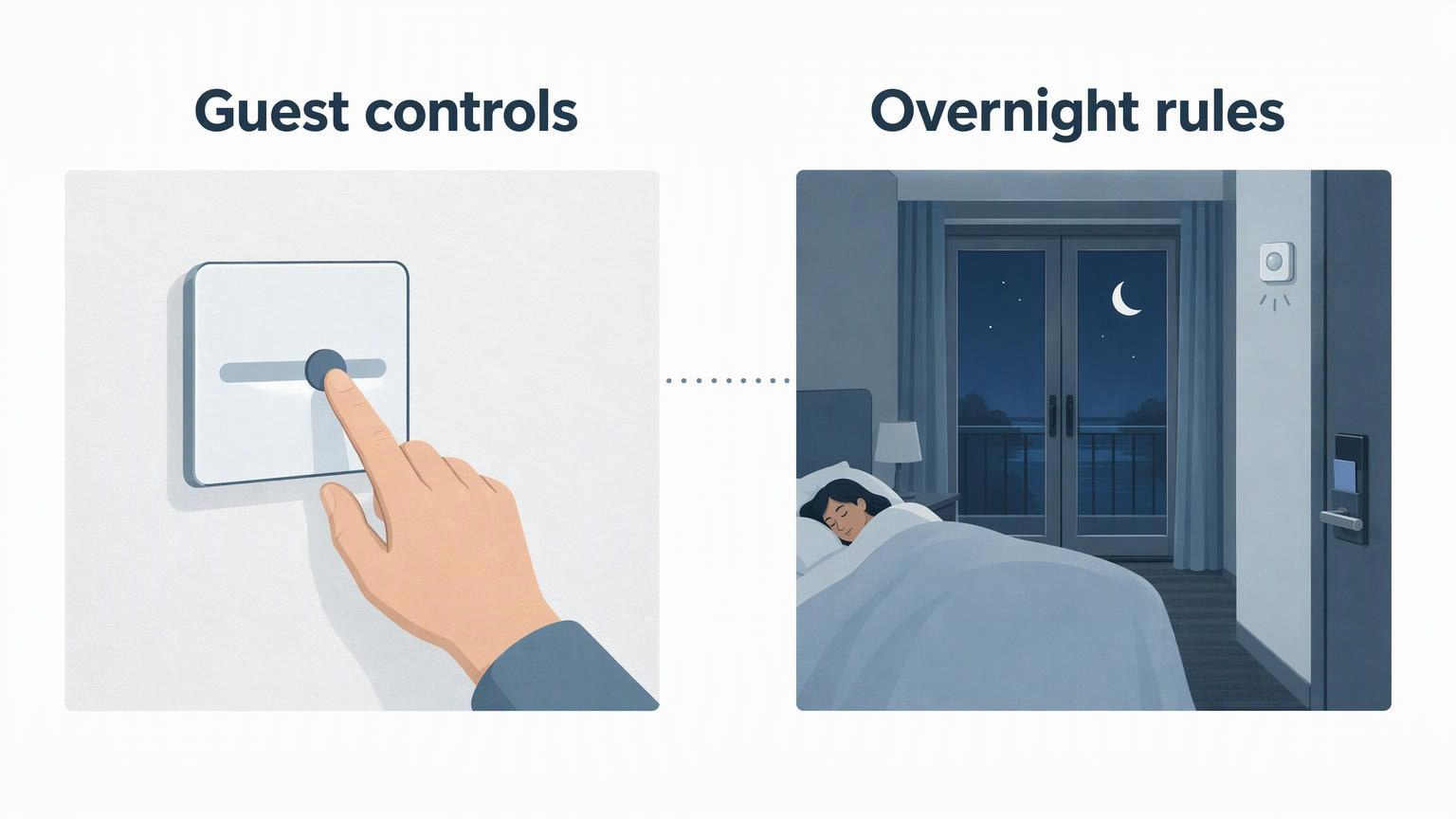
Separate thermostat controls from overnight operating rules
A room can satisfy your control preference but leave an important operating question unanswered. Evaluate what you can select and when the system can operate as separate decisions.
The following are possible arrangements to investigate, not claims about any particular Costa Rica resort. Accept or reject a rule according to how it affects your stay.
Guest adjustment and temperature limits
Determine whether the room has a guest-adjustable controller and whether its available range includes your preferred setting. A remote control or thermostat photo is less useful than a clear answer about permitted adjustment.
If the property describes a minimum setting, compare it with your own requirement. Do not assume staff can override a limit, or that booking a different rate changes it. A room that cannot accommodate your essential setting should leave your shortlist.
Occupancy controls and sleeping guests
If occupancy sensing is used, the relevant question is how it behaves while someone sleeps. A rule described only as "cooling when occupied" leaves that detail unclear.
Distinguish a system that changes settings while everyone is out from one that could affect overnight use. If returning to a warm room is acceptable but interrupted cooling during sleep is not, those arrangements lead to different decisions.
Door switches, key cards, and schedules
A requirement to close balcony doors may fit comfortably with your plan to sleep in an enclosed bedroom. If you want to keep outside doors open, however, that requirement matters.
For any key-card control, establish how normal overnight operation works with guests in the room. For any schedule, establish whether cooling is available throughout your intended sleeping hours. Do not rely on bypassing switches or leaving extra cards behind as the solution to an essential need.
Does cooling reach every sleeping area?
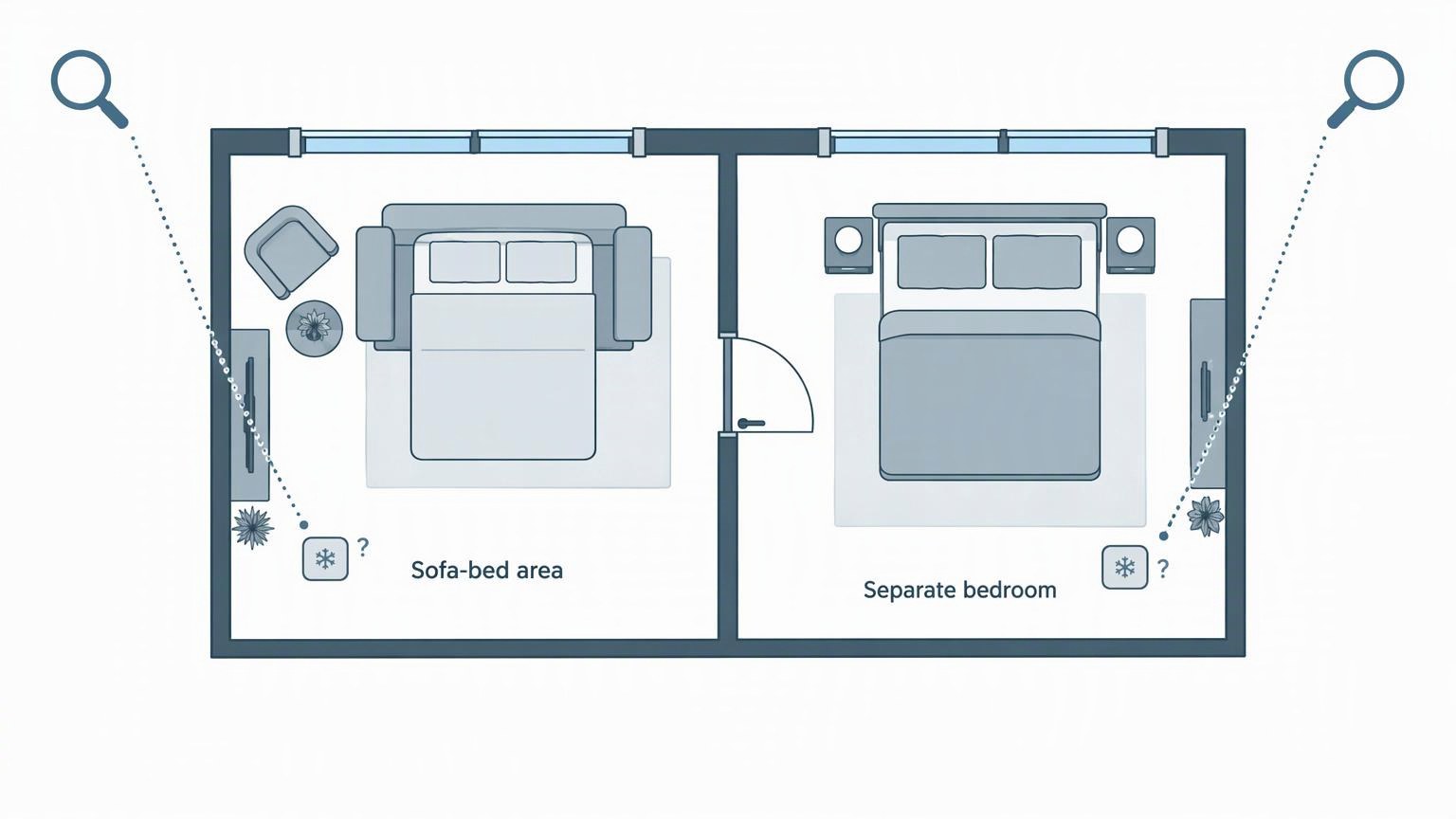
Match cooling coverage to the room layout you will actually use. In a suite, a living area and a separate bedroom are different spaces; a general suite description does not explain how each is cooled.
If someone will sleep on a sofa bed, that area belongs in the comparison too. A bedroom-focused answer will not establish the sleeping conditions for the person outside it.
The useful detail is whether cooling serves each sleeping space in its normal nighttime arrangement. If you plan to close an interior door for privacy, evidence about comfort with that door open does not answer your question.
Also separate equipment layout from comfort preferences. An air outlet directed toward a bed, adjustable fan settings, and equipment sound may influence your choice even when temperature controls meet your needs. Ask about the particular feature that matters rather than accepting "comfortable" as a technical description.
You do not need an engineering drawing. A room-category-specific explanation of the cooling arrangement and sleeping-area coverage is more useful than an attractive floor plan with no equipment information.
Get evidence that matches the room you will pay for
The strongest prebooking answer connects the cooling details to the exact room-category name and your intended stay. A general reply about the hotel is weaker if several room types are available.
Keep the category wording consistent between your question, the response, and the booking selection. If the response concerns a different suite or an unspecified upgraded room, it does not resolve the choice in front of you.
A request can be brief: "For the room category shown in this booking, please confirm the guest-adjustable cooling range, whether cooling remains available while guests sleep, and whether it serves the bedroom with the interior door closed. Please identify any operating restrictions." Add your personal temperature requirement if it is essential.
Evaluate the substance of the answer. "Air conditioning is available" does not settle an overnight operating question; "we will note your preference" describes a request rather than a confirmed room feature.
Keep confirmation separate from special requests
A special-request box is useful for communicating preferences. It is not a substitute for establishing whether the booked category has an essential feature.
Save the relevant room description and written response with your reservation details. If the room category changes before payment, reassess the evidence rather than carrying the previous answer over to the new selection.
Documentation improves the basis for your decision, but it does not create a refund right or guarantee future equipment performance. Booking terms and any supplier commitments still matter separately.
Work through a room comparison before sorting by price
Say you are traveling with someone who needs privacy at bedtime, and you need adjustable cooling throughout sleep. You intend to close the bedroom door, so a large suite with cooling described only for its living area is not automatically suitable.
Picture these descriptions appearing in your shortlist. They illustrate different levels of evidence, not actual resort listings.
| Room option | Available information | Decision |
|---|---|---|
| Standard room | Bedroom cooling, acceptable guest settings, and overnight operation are documented | Suitable for the cooling requirement; assess privacy separately |
| Separate-bedroom suite | Air conditioning is listed, but bedroom coverage is not explained | Keep out of the bookable shortlist until bedroom coverage is established |
| Separate-bedroom suite with detailed cooling information | Closed-door bedroom coverage, acceptable controls, and overnight operation are documented | Suitable for both the cooling requirement and desired layout |
| Ventilated room with a fan | Natural ventilation and a fan are documented; refrigerated cooling is not | Does not meet the stated cooling requirement |
Review Costa Rica stays with cooling as an eligibility requirement
Start with our Costa Rica all-inclusive resort options, then review the room information for the categories you are considering. Exclude options that do not document your essential cooling requirements rather than interpreting a general resort description as confirmation.
At Travel Elite Pass, we bring hotels, flights, cars, and activities into one search, with member-only rates revealed after login. That helps you compare trip components once a room qualifies for your shortlist; a member rate does not establish cooling equipment or operating rules.
Use Travel Elite Pass to compare the eligible options and their total trip price. Our bookings are processed through the platform's own checkout, and cancellation and refund terms vary by the supplying hotel or airline and are shown at checkout for each booking.
If a room leaves an essential cooling detail unanswered, pause before committing to it. The downside is a smaller shortlist and possibly more time spent comparing. For someone whose sleep depends on the answer, that is a reasonable trade-off.
Frequently Asked Questions
Should I pay more for a cooling-related room upgrade?
Pay more only if the upgraded category documents a cooling difference that matters to you. Extra space, a better view, or a premium label does not establish better overnight cooling. Compare the confirmed room features and the all-in booking totals before deciding whether the upgrade addresses your actual need.
Can December travel replace the need to verify room cooling?
No. Choosing December does not establish a room's controls, cooling coverage, or overnight operating rules. If cooling is essential to your sleep, evaluate the room on that basis regardless of travel month. Let seasonal preferences influence the vacation after the room has passed your essential requirements.
Are guest reviews enough to judge whether I will sleep comfortably?
Guest reviews are not enough to establish a specific cooling requirement. Another person's idea of a cool room may differ from yours, and their room category may be different. Use observations to identify questions, then base an essential requirement on room-specific information rather than a general comfort impression.
What if the cooling information changes after I reserve?
Compare the new information with your saved room description and written confirmation, then review your booking terms. Contact the booking provider and property to establish what applies to your reservation. Do not assume a change automatically creates a refund entitlement; cancellation and refund conditions depend on the particular booking.
What should I do if the room is too warm on arrival?
Report the issue to the property promptly and describe the room conditions and control settings. Ask staff to explain normal operation and inspect the equipment if needed. Keep a record of the response and any proposed remedy, but do not assume a room move or refund is automatically available.
How far ahead should I resolve a medical cooling need?
Resolve an essential medical cooling requirement before making a payment you cannot comfortably reverse. Ask your treating clinician what conditions matter for your situation, then communicate those requirements clearly when evaluating the room. A general air-conditioning label should not be treated as assurance that a medically necessary temperature can be maintained.