

RESORT TRIP PLANNERS
For travelers holding airfare with a separate seller, these checks explain when a resort reservation is a reasonable commitment and when to wait.
Cheap round trip flight deals can leave you with a difficult booking-order decision: the airfare is on hold, but the resort room is ready to buy. The useful question is whether that hold protects enough of your trip to justify the money you would commit to accommodation.
Keep the flight seller's terms beside the resort's checkout conditions. A displayed itinerary, a payment receipt and an issued ticket answer different questions. The five checks below separate those stages so you can choose between waiting, reserving a cancelable room and accepting a known financial risk.
1. When does the fare hold actually expire?
Use the expiry date, exact time and time zone written in the flight seller's hold confirmation. Do not substitute the time you opened the email, your local midnight or an assumed standard hold period.
Next, identify what must happen before that deadline. Submitting payment, having payment accepted and receiving issued tickets are separate milestones; the seller's terms should identify which one keeps the reservation from expiring.
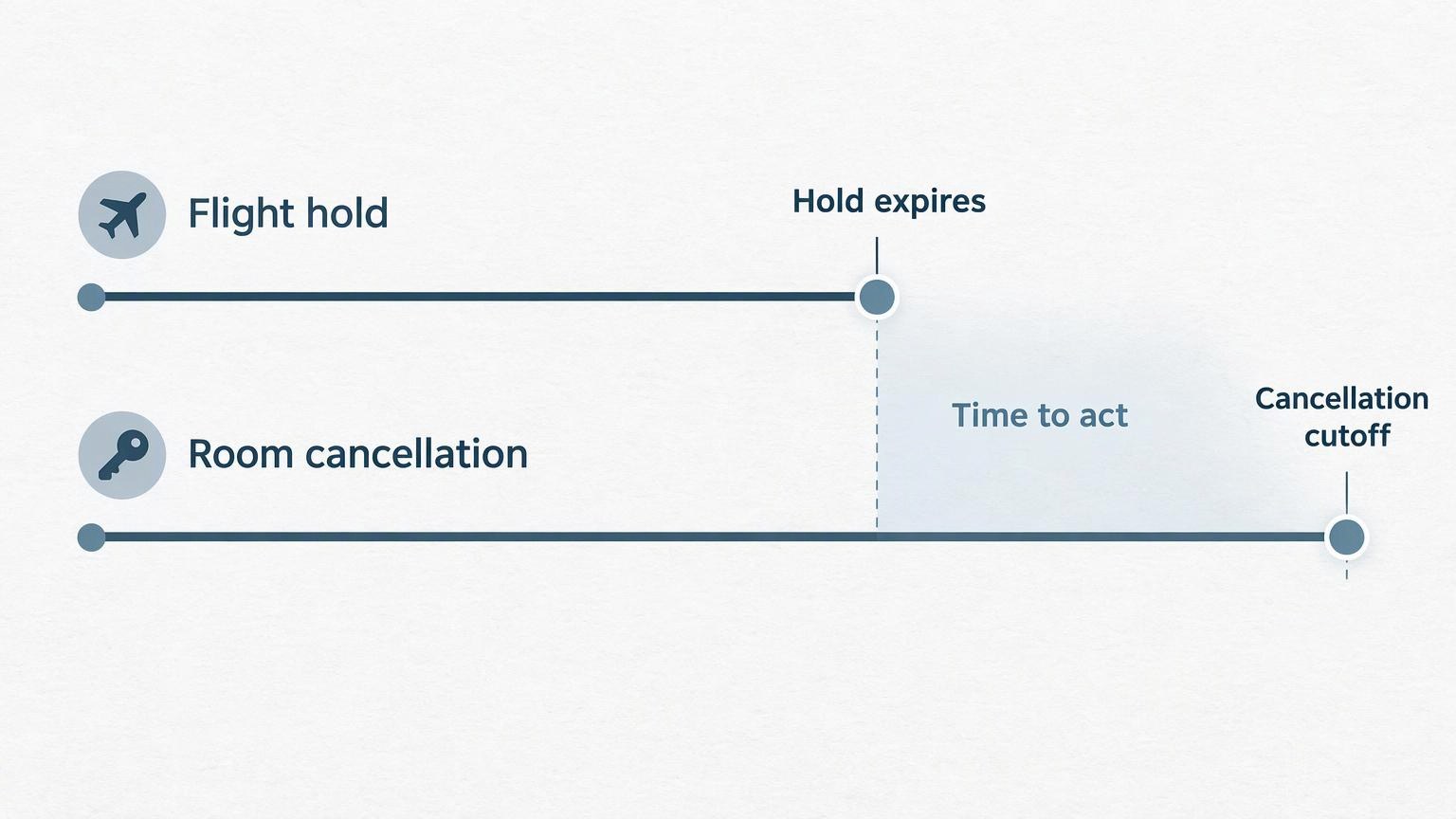
The accommodation deadline matters just as much. Compare the flight hold's expiry with the last point at which you can cancel the resort under the room's stated terms, and leave yourself time to act if ticketing does not finish.
A room with a cancellation cutoff before the flight issue is settled does not provide the flexibility you need, even if its rate is labeled refundable. Your decision depends on the usable cancellation window, not the label alone.
For last-minute round-trip flight deals, make this comparison before starting the resort checkout. If the deadlines leave no practical time to resolve a payment or ticketing question, completing the flight first is the more cautious order.
2. What price and itinerary does the hold protect?
Read the hold as a defined promise, not a general assurance that your trip is secured. Establish whether it protects a quoted price, a reservation on specified flights, or both, and whether any conditions can change that protection.
The scope should match the trip you intend to buy. Compare the outbound and return flights, travel dates, airports, fare type and traveler names against the hold confirmation.
If you are booking for more than one person, establish that the hold covers everyone at the quoted terms. A protected fare for one traveler does not settle the accommodation decision for the rest of the party.
Also separate the held airfare from the complete amount you intend to spend. Include applicable taxes, seller charges and any baggage or seat choices you need when comparing the all-in total; do not assume optional purchases are protected merely because the airfare is held.
This check prevents an expensive mismatch. A resort stay built around a particular arrival date is a different purchase if the held itinerary turns out to cover a different date or only the outbound journey.
The best round-trip flight deals for your trip are the ones whose confirmed itinerary and complete price fit your stay. A lower headline fare with unclear protection is not a sound basis for a nonrefundable room.
3. What counts as completed payment?
Identify the payment step the seller requires to convert the hold into a purchase. Look for the amount due, accepted payment method and the status that confirms the seller has accepted payment.
A card notification is evidence about a payment event, not an answer to every booking question. Do not use it alone to decide that the airfare has been fully purchased or ticketed.
If the checkout returns an error or remains pending, inspect the existing reservation and payment status before trying again. Ask the seller how to proceed rather than treating a second payment attempt as the automatic solution.
Include any hold charge in your cost comparison if the seller applies one. Establish whether that charge is separate from the airfare, credited toward it or refundable under stated conditions; none of those treatments should be assumed.
The accommodation implication is straightforward: incomplete payment leaves an important step between your hold and completed flight booking. Keep your room commitment reversible while that step remains open, unless you are willing to carry the loss yourself.
4. How will you know the tickets are issued?
Ask the seller what document or reservation status confirms completed ticket issuance for this booking. A booking reference identifies a reservation, but it is not a substitute for establishing that ticketing is complete.
Where the seller provides an e-ticket receipt or ticket numbers, match them to each traveler and the intended round-trip itinerary. If the confirmation is ambiguous, request explicit confirmation of the ticketing status before making an irreversible accommodation purchase.
Do not stop at the first passenger's confirmation. The resort decision concerns the whole traveling party, so establish that every intended traveler has the required flight documentation.
Keep the seller's payment receipt and issued-ticket confirmation together. They let you distinguish a payment problem from an issuance problem when requesting help, without relying on memory or the appearance of the original search result.
Ticket issuance answers whether the purchase has reached that stage. It does not promise that the trip will operate without changes, so the resort's cancellation and change conditions still deserve a separate decision.
5. What happens if you do not complete the hold?
Read the hold's exit terms before paying for the room. Establish what happens if you let it expire, cancel it yourself, cannot complete payment or pay but do not receive ticketing confirmation.
Those outcomes need not have identical treatment. Look for any hold charge, refund conditions, required cancellation action and instructions for resolving a payment without issued tickets.
Then read the resort's terms independently. Your flight hold expiring is not evidence that a separately purchased room can be canceled without a charge.
Focus on the moment the accommodation becomes a financial commitment: immediate nonrefundable payment, a deposit with specified deductions, or a later cancellation cutoff. A pay-later arrangement should not be treated as risk-free unless its cancellation conditions support that conclusion.
Save the applicable conditions from both transactions. For the room, retain the cancellation deadline, time zone, method of cancellation and stated financial consequences.
The downside of separate purchases is that the favorable outcome of one transaction does not establish rights under the other. Only rely on protection that is written into the relevant booking terms.
Which booking order fits your risk?
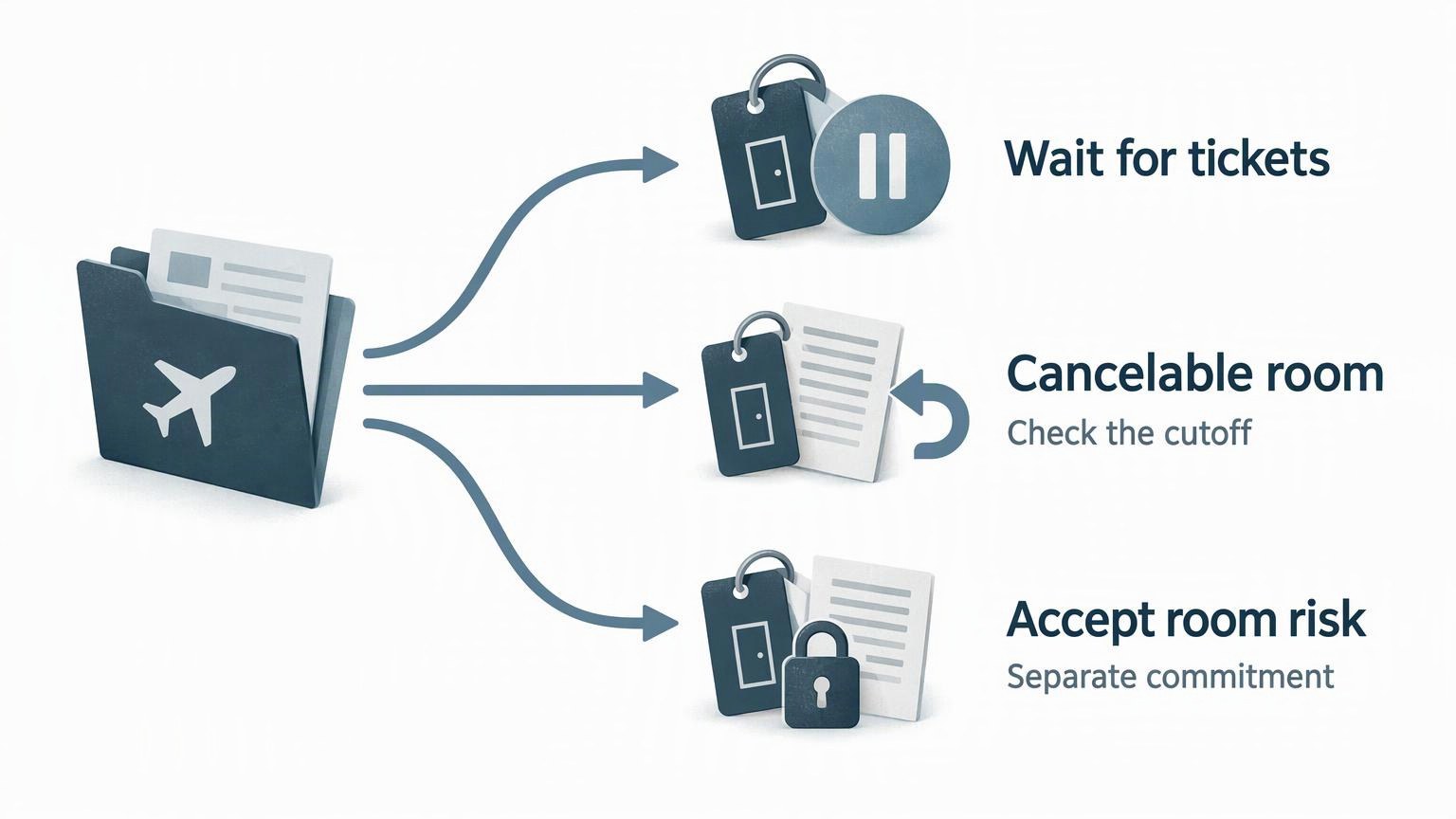
Choose your booking order according to the loss you would accept if the held airfare does not become the flight purchase you expected. Waiting is sensible when the room commitment is difficult to reverse; reserving first can be reasonable when the room terms give you a workable exit.
The comparison below is a decision framework, not a promise that a particular rate or room will remain available. Use the actual terms attached to your accommodation choice.
Use the cancellation cutoff, not just the payment date
Your exposure is the amount you would lose under the room's terms if you canceled when necessary. That amount matters more than whether the seller has already collected the money.
Before checkout, read the rate-specific terms alongside the room details and all-in total. Our guide to booking an all-inclusive resort provides further context for the accommodation purchase.
| Choice | When it fits | Main trade-off | Decision trigger |
|---|---|---|---|
| Wait for ticket issuance | The room would create an immediate loss if flights fall through | You have not secured the accommodation while waiting | Confirm flight ticketing before accepting the room commitment |
| Reserve a cancelable room | Its written cancellation window leaves time to resolve ticketing | You must monitor and act before the room's cutoff | Cancel under the room terms if the required flight certainty does not arrive |
| Commit to a nonrefundable room | You can use the stay with another flight or knowingly accept losing the room payment | The airfare hold does not remove the accommodation risk | Proceed only after accepting the separate loss exposure |
Say your preferred room is ready, but the flights are not ticketed
Say you and a companion have an external hold covering the outbound and return itinerary you want. You have found a resort stay, but the flight seller has not yet confirmed ticket issuance.
Compare a room rate that allows cancellation under a written deadline with another that becomes nonrefundable at purchase. First establish whether the cancelable rate's deadline leaves enough time to complete flight payment, receive ticketing confirmation and cancel the room if needed.
If it does, reserving that room can be a reasonable bridge. You would then finish the flight purchase, verify issuance for both travelers and keep the room only after the result supports your plans.
If the room's cancellation cutoff arrives before you can establish ticketing, its refundable label does not solve the problem. Waiting for the flights is the more cautious choice, even though it means leaving the accommodation unsecured during that interval.
The nonrefundable rate has a different test. Would you still use the stay if you had to buy a different flight at a total you could afford, or would losing the room payment cause a financial problem?
If your trip depends entirely on the held fare, wait before accepting that rate. If you can absorb the consequences and deliberately choose to commit, recognize that you are accepting risk rather than obtaining certainty from the hold.
Choose the resort destination without treating it as flight protection
At Travel Elite Pass, we provide member-only rates and an Exclusive Resort Collection, with a focus on all-inclusive stays in Mexico and the Caribbean. That gives you an accommodation comparison for the trip you are planning around the externally held airfare.
Start with a resort destination on Travel Elite Pass, then compare the stay's all-in total and rate-specific conditions. Member-only prices are revealed after login, and cancellation and refund terms vary by the supplying hotel and are shown at checkout for each booking.
Keep the roles separate: the flight seller establishes what your airfare hold protects, while the accommodation terms establish what money you would commit to the stay. A room price comparison does not verify an external hold or guarantee a cheap flight.
You can shortlist accommodation while the airfare remains on hold. Before purchasing, return to the flight seller's conditions and make sure the chosen booking order fits the risk you are prepared to accept.
Frequently Asked Questions
What should I send the flight seller if my reservation status is unclear?
Send the booking reference, the hold confirmation and the relevant payment receipt, and ask whether payment and ticket issuance are complete. State which travelers or flight directions need clarification. Request a written answer identifying the current status and the next required action rather than relying on a vague assurance that the booking is fine.
Can an AI assistant verify that my fare hold is secure?
An AI assistant can help you interpret the terms you provide, but its answer should not replace confirmation from the flight seller. Ask it to separate expiry, protected itinerary, payment and issuance requirements, then verify ambiguous points with the seller. Do not treat a generated explanation as evidence that tickets have been issued.
What if my companion is not ready to commit?
Do not assume your companion's flight or accommodation commitment is settled because yours is ready. Establish whether the held airfare covers that traveler and whether the room's occupancy and cancellation terms fit the final party. If their decision determines whether you can use the stay, keep the accommodation reversible or wait.
Should I abandon the hold if a lower fare appears?
Compare the replacement's complete cost and confirmed itinerary before abandoning the existing hold. Include any applicable hold charge and the baggage or seat choices you need, then inspect the replacement's purchase terms. A lower displayed fare is not enough if switching leaves you without a usable flight for accommodation you have already committed to.
Does Travel Elite Pass set the terms of a flight hold bought elsewhere?
The separate flight seller's conditions govern that external hold. Use Travel Elite Pass to compare the accommodation purchase, and use the flight seller's confirmation to establish expiry, payment requirements and ticketing status. Keep the records together so your room decision reflects both transactions without assuming that one seller's terms extend to the other.
Is waiting for ticket issuance enough to make a nonrefundable room risk-free?
No. Waiting resolves the specific uncertainty about whether your held airfare has been ticketed, but it does not make a nonrefundable accommodation purchase risk-free. Consider whether you could still use the stay if your travel plans changed, and read the room's cancellation and change terms before accepting the financial commitment.