

RESORT VACATION BUYERS
For travelers arriving late or leaving early, meal coverage matters only when an included dining option is available while you are at the resort.
A late arrival can make the first dinner irrelevant even when dinner belongs to the meal plan. An early pickup can create the same problem with your last breakfast. Neither issue is answered by the words all inclusive vacation packages on a booking page.
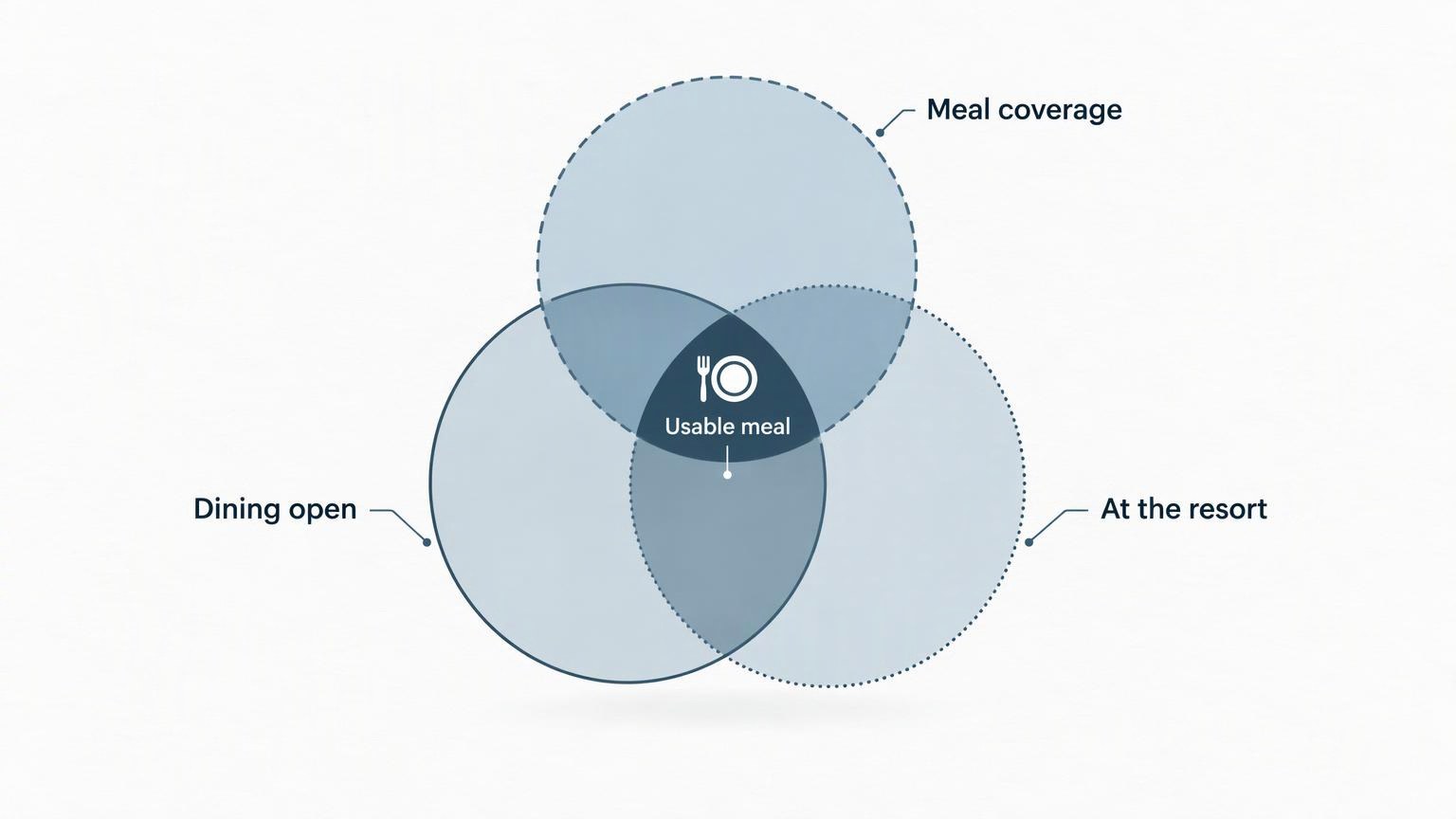
Your decision depends on the overlap between your stay's meal entitlement, the resort's dining schedule, and the time you are actually there. Keep those separate while comparing offers. A room you can occupy, a restaurant that is open, and a meal included in your rate are different pieces of the purchase.
Separate accommodation nights from meal coverage
A count of nights describes the accommodation you are buying. It does not, by itself, identify the first meal you may use on arrival or the last meal you may use on departure. Avoid converting a nightly stay description into a promised meal count.
For this decision, distinguish three pieces of information. Meal eligibility tells you what your booked rate covers and when that coverage applies. Dining availability tells you which included service is operating. Your itinerary tells you whether you can reach that service before it ends.
A useful arrival dinner must satisfy all three. Coverage without an open dining option will not feed you; an open restaurant without coverage may require separate payment. Even when both are in place, a travel schedule that gets you there too late makes that dinner unusable.
Room access is a separate entitlement
Do not use the room check-in time as a substitute for the meal plan's start time. Likewise, a room checkout deadline is not enough evidence to establish the last included meal. Look for language that addresses the food-and-beverage entitlement itself.
If an offer mentions early check-in, late checkout, or luggage storage, treat that as information about the named service. It answers the meal question only if the terms explicitly connect it to dining access.
A dining description is not a boundary-day promise
A list of restaurants helps you understand the resort's dining choices. It does not establish that those choices will be open, included, and accessible on your arrival or departure day.
For resorts that are all-inclusive, assess the specific rate you intend to purchase rather than relying on the category label. The useful evidence names the meal plan and explains how its beginning and ending apply to your stay.
Will a late arrival leave you without an included dinner?
It will if you reach the resort after the included dinner service ends and there is no confirmed included alternative available then. Dinner may be covered by the rate, but coverage alone does not establish late-night service.
Start with your expected arrival at the resort, not your aircraft's landing time. Account for the steps between landing and reaching reception using your actual travel arrangements. Keep airport arrival and resort arrival as separate entries in your plan.
Then compare the resort arrival with the dining option's last admission or ordering time. A venue's closing time may not answer how late you can begin a meal, so ask for the relevant cutoff rather than assuming you can walk in just before closing.
Evaluate the fallback as a meal you would actually use
If a late snack, room service, or another option is proposed, establish its inclusion, operating hours, and suitability for your party. A service name is not enough to show that it will provide the meal you need.
For someone managing a food allergy, a late option also needs an appropriate food-safety conversation. The dining guidance on Triptipedia recommends asking staff about ingredients and allergy concerns; apply that check to the actual service available after your arrival, not only to the main restaurant.
Allow for an arrival later than planned
A meal plan that works only if every travel step runs on time gives you less room for disruption. Decide whether you are comfortable arranging food separately if you miss the confirmed service window.
You do not need to reject an otherwise suitable resort over one dinner. But make the choice knowing what happens if you arrive hungry after service ends, rather than treating an unconfirmed late meal as part of the value.
Can you use breakfast before an early departure?
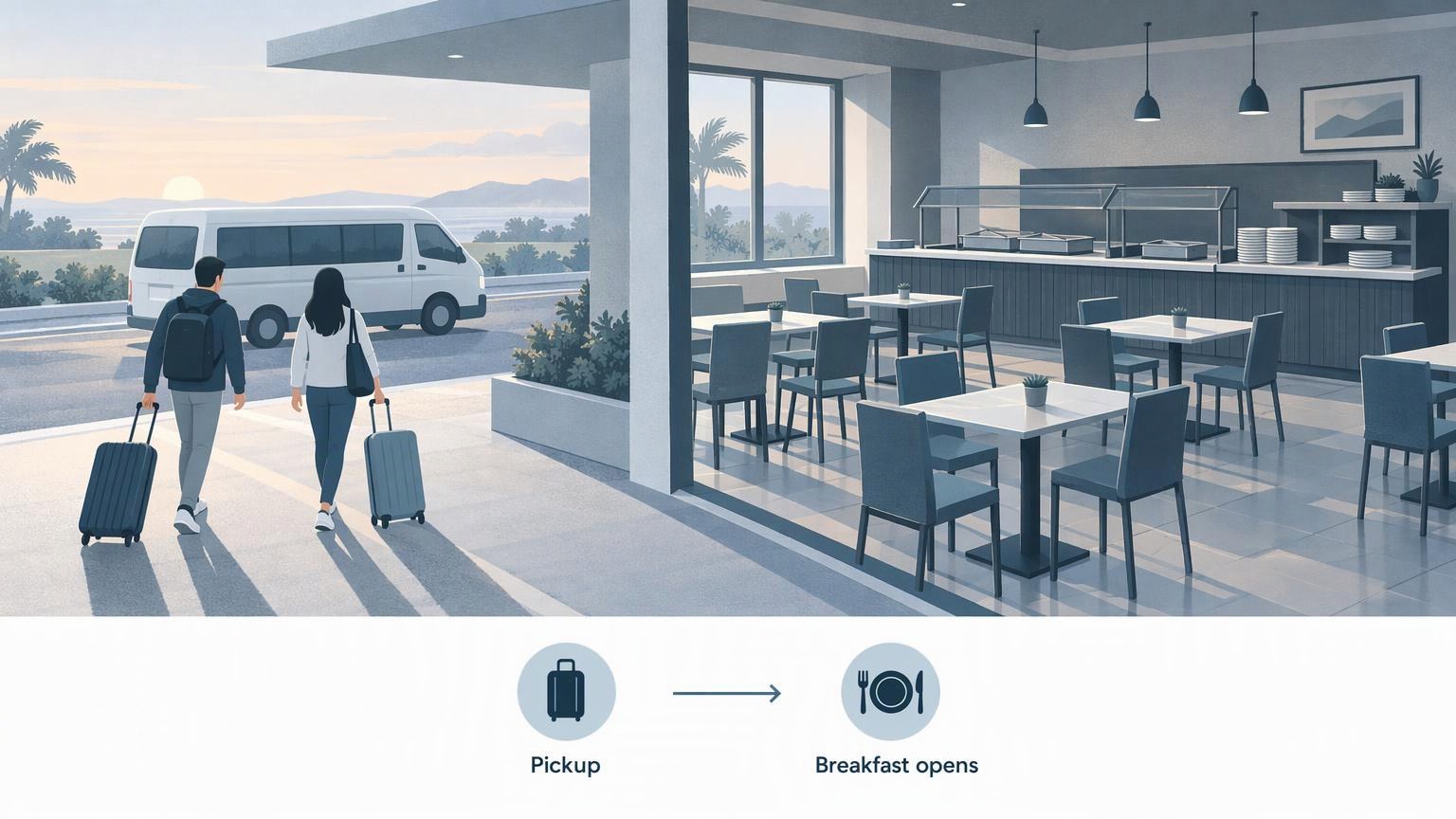
You can use it only if departure-day breakfast is included and an appropriate service is available before you must leave the resort. The relevant comparison is breakfast access versus pickup or departure from the property, not breakfast versus flight departure.
Work backward from the time your transport requires you to be ready. Allow time to eat and complete your departure arrangements. If breakfast service begins after you must leave, that breakfast has no practical value to this itinerary, regardless of how appealing the restaurant is.
Look for the departure-day meal entitlement separately from the arrival-day terms. Confirmation that your first dinner is included does not answer whether your last breakfast is included.
Do not assume an early breakfast substitute
If you need food before the normal breakfast service, an early dining option or food prepared for departure would help only if the property confirms it for your stay. Establish whether it is included, whether advance arrangements are required, and whether it suits your needs.
Without that confirmation, plan on a separate breakfast arrangement. This is a manageable difference in value, but it belongs in the comparison before payment.
A later departure raises a different question
If your plans shift and you will remain after room checkout, establish when food-and-beverage coverage ends. Permission to wait at the property is not the same as permission to keep using the meal plan.
Consider a coverage extension only when its actual terms fit the time you will remain. Paying for additional access makes little sense if your transport leaves before you can use the next meal.
Compare ways to handle a meal gap
A missing boundary-day meal does not automatically make an all-inclusive stay poor value. Its importance depends on the rest of the stay, your food needs, and the cost or inconvenience of the alternative. Compare the solution to the gap, rather than judging the whole purchase by one unusable meal.
Use the same travel dates, occupancy, room category, and rate conditions when comparing resort offers. Then add the costs needed to make each itinerary work, including separate meals or an extension you would actually purchase. Include applicable taxes, fees, and resort charges in the total.
Give meals a usable value, not a theoretical count
For your personal comparison, count an arrival or departure meal as usable only when coverage, service, and presence overlap. Keep an uncertain meal out of the benefits you rely on until its terms are clarified.
This does not require assigning every meal a dollar value. You can decide that a separate arrival dinner is acceptable while an unavailable early breakfast is not, particularly if someone in your party needs a dependable eating schedule.
| Choice | When it makes sense | What must be established | Trade-off |
|---|---|---|---|
| Keep the stay and arrange a separate meal | The gap is limited and the resort fits the rest of your trip | A practical food option and its current cost | Adds a separate expense and some planning |
| Change travel timing | A different arrival or departure would let you use a confirmed included meal | The revised itinerary reaches the dining window and the full trip total remains acceptable | Travel changes may cost more than the meal they recover |
| Choose a stay with suitable dining coverage | Eating at the resort on boundary days matters to your party | The selected rate covers an available service at your expected times | A better timing fit may mean a different room, property, or total price |
| Purchase additional meal access, if available | The property has a confirmed option that fills your specific gap | Eligibility, hours, price, and any advance arrangement requirement | An extension does not help if dining is closed or you have already left |
A worked decision: late arrival and early pickup
Say you are comparing resort stays for a trip with an evening arrival and an early departure pickup. You expect to eat at the resort during the full days between them, but you do not want to depend on finding food after a tiring journey.
One offer has written confirmation of an included dining service that fits your expected arrival. Another has a lower booking total but no confirmed included service after you expect to reach the property. Neither offer establishes a usable breakfast before your pickup.
The first offer solves the arrival problem, assuming the available food suits your party. It does not solve the departure problem. You would still need to arrange breakfast separately or establish a suitable early option.
For the second offer, compare its total plus a realistic separate arrival meal and departure breakfast with the first offer's total plus departure breakfast. Do not credit the second offer with an included dinner you cannot establish that you can use.
If you are comfortable with the separate arrival arrangement and it preserves the better overall value, the second offer can be the sensible choice. If dependable food on arrival matters more, the first may justify its higher total. The deciding difference is usable service, not the all-inclusive label.
Now picture the same trip with an arrival that falls very near the confirmed dining cutoff. The first offer's advantage becomes less dependable. Before changing your flight solely to recover that dinner, compare the travel change against the separate-meal alternative.
Tie the meal terms to the booking you will purchase
Useful confirmation identifies your selected rate, travel dates, and meal plan. A general answer about what the resort includes is less helpful if it does not address the arrival and departure times you are planning around.
Keep the rate description, applicable inclusion terms, and any written clarification together. Save the dining hours you used for the comparison as well. Meal entitlement and the service schedule answer different questions, so retaining only one leaves part of the decision undocumented.
A focused inquiry can read: For this rate and these stay dates, what is the first included meal on arrival and the last included meal on departure? My expected resort arrival is after the main dinner period, and my departure pickup is before breakfast. Which included food services can I use at those times?
If the reply explains room check-in or checkout but not meals, ask for the food-and-beverage terms specifically. If no usable option is established, compare the stay on the basis that you will arrange that meal separately.
Our guide to booking an all-inclusive resort provides broader booking context. For this narrower decision, finish by matching the exact rate's meal terms to your boundary-day itinerary before you commit.
Know what happens if the schedule changes
Review cancellation and change terms alongside meal coverage, especially if you are still choosing travel times. A dining solution that depends on one arrival window may stop working after an itinerary change.
Do not assume that an unused meal creates a refund, replacement meal, or credit. Those outcomes require their own applicable terms; the original inclusion alone does not establish compensation.
Use Travel Elite Pass for your next stay comparison
At Travel Elite Pass, we provide member-only rates, an Exclusive Resort Collection, and an AI Deal Finder. Member prices are revealed after login, giving you a rate to evaluate alongside the stay's inclusions and total trip cost.
A member rate does not replace the supplier's meal terms. We process bookings through our platform's checkout, where cancellation and refund terms vary by the supplying hotel or airline and are shown for each booking. Treat your resort meal coverage as a separate part of the purchase to establish before payment.
For a Cabo stay comparison, review our Cabo all-inclusive resorts page. Check any published arrival-day and departure-day inclusion terms for the stay you select, then resolve any meal timing you need to rely on before booking.
The useful result is a resort rate paired with dining coverage that fits your itinerary. Searching hotels and flights on the same platform does not, by itself, establish that a selected resort offer includes airfare.
Frequently Asked Questions
Does an all-inclusive resort offer automatically include flights?
No. A resort meal plan and airfare are separate components unless the selected offer explicitly includes both. Check the booking description for flights, transfers, and the resort stay individually. Having hotel and flight search available on one platform is not evidence that the resort rate you are viewing includes air travel.
Can a missed arrival dinner be moved to departure day?
Do not assume that a missed dinner can be exchanged for a later meal. Ask whether the selected rate has an explicit substitution or credit provision, and retain the applicable terms. Without that provision, evaluate departure-day dining on its own coverage window rather than treating the unused arrival dinner as transferable value.
How much should I budget for meals outside the coverage window?
Use current prices for the food arrangement you would actually choose; there is no verified universal amount to apply. Include everyone in your party and any applicable charges. Then compare the full booking total plus those meals against a stay with confirmed usable coverage, rather than comparing advertised resort rates alone.
Is an included late snack enough for a family arriving hungry?
It is enough only if the confirmed food and service meet your family's needs. Establish what is available at your expected arrival, whether it is included, and whether it works for any dietary requirements. If the option would leave someone needing another meal, include that separate food arrangement in your comparison.
Should I book an extra night just to get breakfast before leaving?
An extra accommodation night is not proof that breakfast will be available before your departure. First establish the meal entitlement and service hours for the changed stay. Compare the additional booking cost and any travel changes with a separate breakfast arrangement; buying more room time may not solve the food-timing problem.
What should I do if my flight changes after I book?
Recalculate your expected resort arrival or departure and test it against the dining windows you relied on. If the overlap disappears, review the booking's change and cancellation terms before modifying the stay. Ask about a suitable food alternative, but do not assume a flight change automatically extends meal coverage or creates compensation.