

FLIGHT AND RESORT BOOKERS
Separate flight taxes from accommodation charges, identify what is already included, and compare the amount you will actually pay.
For a Cabo trip, keep the accommodation quote beside the airfare quote rather than treating the resort's all-inclusive description as evidence about flights. The comparison below separates the components, explains payment timing, and shows how to handle a quote that leaves part of the tax treatment unclear.
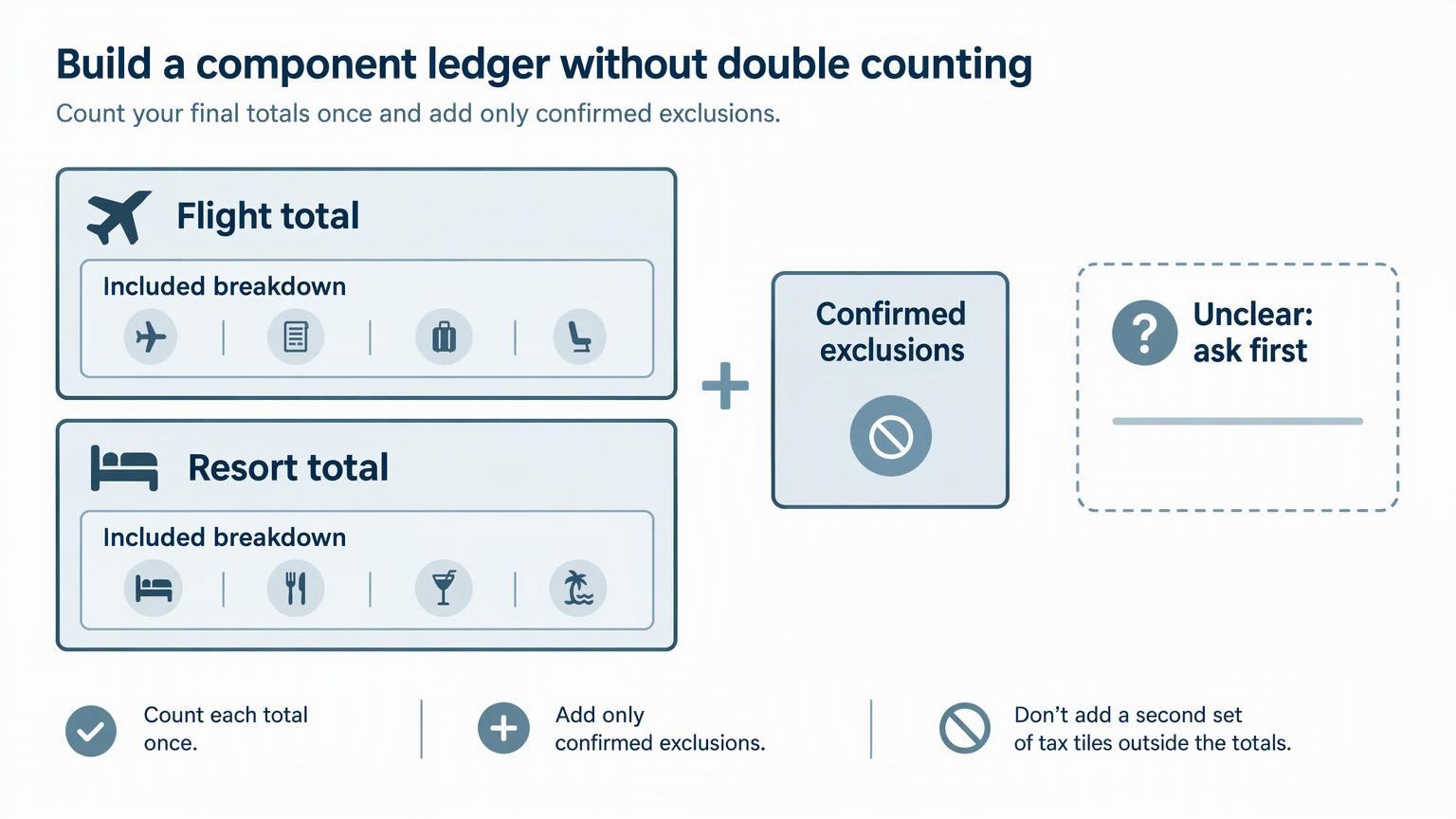
Build a ledger before comparing the quotes
Use the flight's final total and the resort's final total as your starting amounts. Keep their tax breakdowns underneath those totals as explanatory entries, not additional purchases. Only a charge explicitly excluded from the starting amount belongs in the extra-cost column.
Give each charge an inclusion status: included in the quoted total, excluded from it, or unclear. Record payment timing separately. Record who collects it and whether it applies per traveler, per room, per night, or per stay, using the wording in your actual quote. Leave an unknown amount blank rather than entering zero.
The ledger below is a comparison tool, not a list of charges that necessarily apply to your trip. Create a row only when your booking information identifies that component. Preserve the original charge name so you can match it to the checkout breakdown later.
Choose the correct starting total
If you have separate flight and resort quotes, start with each component's final total. If you have a combined package quote, start with the package total instead. Adding its flight and hotel breakdowns again would count the underlying purchases twice.
A package that provides no component breakdown can still state a complete payable amount. What matters for this comparison is explicit treatment of taxes and mandatory charges, including any balance outside the package payment. Itemization helps explain the bill, but it is not the only way a quote can establish inclusion.
| Component | What to record | When to add it to the trip total |
|---|---|---|
| Flight total | Final airfare amount for the selected travelers and itinerary | Once, unless already inside a combined package total |
| Flight taxes | Named tax lines and whether the airfare total includes them | Only if explicitly excluded from the flight or package total |
| Carrier-imposed charges | Airline charge names, amounts, and inclusion wording | Only if outside the total already counted |
| Resort total | Final stay amount for the selected room, dates, and guests | Once, unless already inside a combined package total |
| Accommodation taxes | Named tax lines and whether the stay total includes them | Only if explicitly excluded from the stay or package total |
| Mandatory property charges | Charge name, calculation basis, collector, and inclusion status | Only the portion excluded from the total already counted |
| Selected extras | Extras you actually intend to purchase and their prices | Only if not already included in the comparison |
What does the airfare tax breakdown actually tell you?
The airfare breakdown tells you how the ticket price is composed. It does not, by itself, tell you that the tax amounts are additional to the displayed total. Read the labels around the amount: base fare, taxes and fees, total, and amount due.
For your ledger, distinguish a named government tax from a carrier-imposed charge when the booking provides that distinction. A broad heading such as taxes and fees is not enough to classify every line beneath it as a government tax. Preserve the label rather than replacing it with a more specific description you cannot establish.
To answer whether your plane ticket price includes taxes, use the selected itinerary's final price breakdown. If it shows a base fare plus tax lines equaling the total, record the total once. If the quote explicitly excludes a named charge, record that exclusion separately.
Use the same passengers and itinerary throughout the comparison. Changing the route or cabin while inspecting taxes changes the purchase being compared. You cannot isolate a tax difference by comparing tickets with different underlying travel details.
Keep optional flight purchases separate
A bag or seat purchase is a different ledger entry from a named ticket tax. Include an extra in your trip comparison if you intend to buy it and its price is outside the flight total. Do not classify it as a tax simply because it appears at checkout.
This distinction keeps the tax comparison narrow without pretending extras do not matter. A quote can be complete on taxes yet still cost more after your selected additions. Compare the amount for the flight you intend to purchase, not only its base fare.
Resort taxes and resort fees are different entries
Use accommodation taxes for charges identified as taxes on the stay. Use a separate entry for property-imposed charges identified as fees. The word resort in a charge name does not establish that it is a government tax, and the phrase all-inclusive does not establish its payment treatment.
Keep the resort's service inclusions separate from its price inclusions. Meals or drinks described as included answer what the stay covers. Tax wording answers how the quoted stay price accounts for taxes. Our explanation of what an all-inclusive resort stay includes helps with the service side of that distinction.
For a Cabo accommodation quote, rely on the selected booking's breakdown rather than importing a tax percentage from another destination or property. No universal percentage is needed to reconcile a quote that already provides a final tax-inclusive total. If it excludes a charge without stating the amount or calculation, the total cannot yet be completed.
Read the calculation basis as carefully as the amount
A room-level amount and a traveler-level amount are not interchangeable. Copy the quoted basis before extending a charge across the stay. Do not multiply a full-stay total by the number of nights, or multiply a room charge by every guest.
If a tax is already included in the room's final total, its calculation basis is explanatory. If it is excluded, the basis determines what you must add. Where the quote gives a percentage but does not identify the taxable amount, request the actual payable amount rather than assuming the percentage applies to every part of the stay.
How do you reconcile included charges with payment timing?
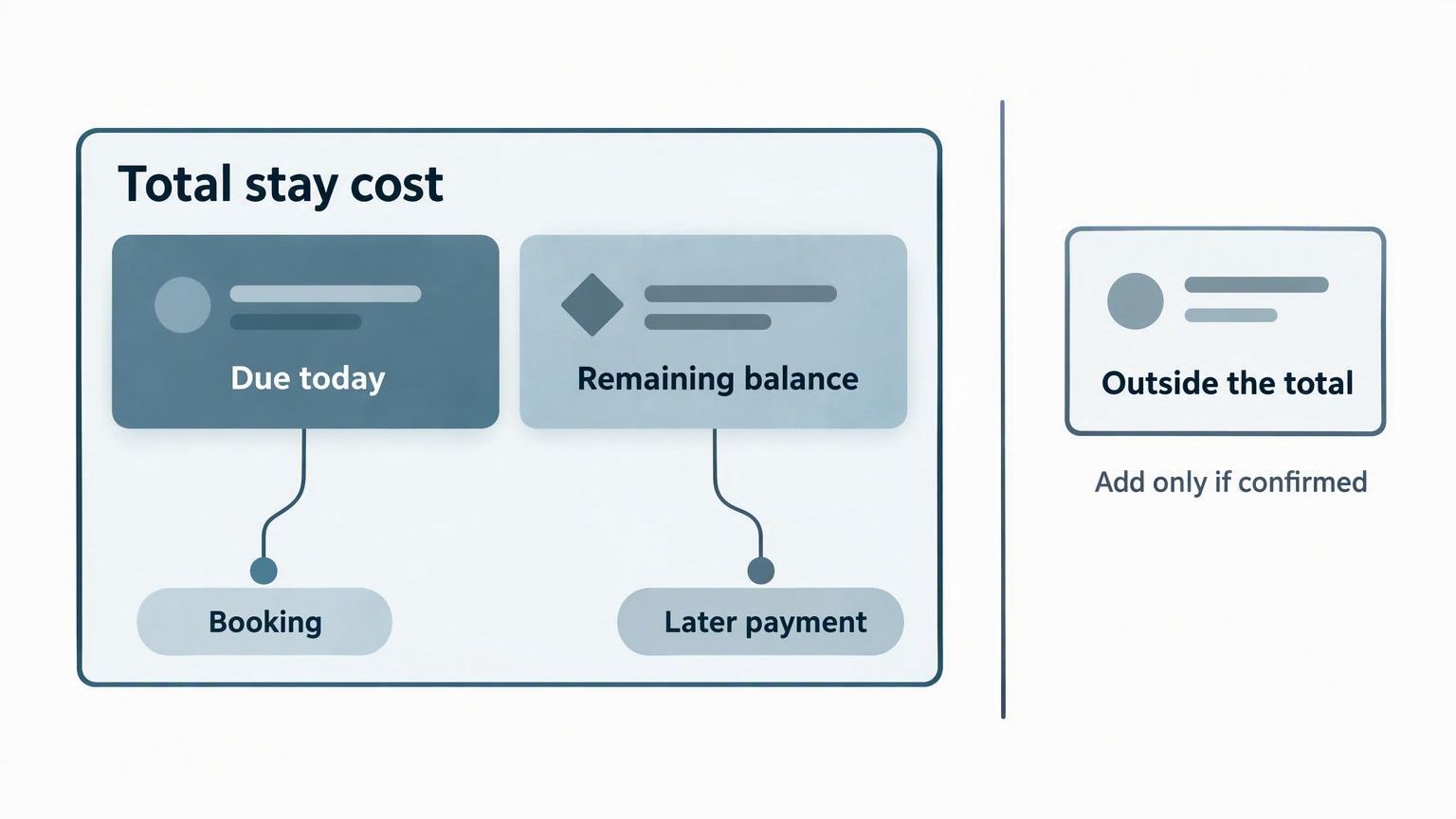
A charge can be included in the total trip price while being collected later. Inclusion answers whether the quoted total accounts for it; payment timing answers when and to whom you pay it. Keep those questions in separate columns so a later payment does not automatically become an extra cost.
Read phrases such as total stay cost, due today, remaining balance, and payable at property together. A number labeled due today is not necessarily the full stay total. Conversely, a disclosed property payment should not be added again if the full stay total explicitly includes it.
For separate reservations, calculate the trip cost as the final flight total plus the final resort total, then add confirmed mandatory amounts excluded from both. Add selected extras separately. For a combined package, use the package total and add only confirmed amounts outside it.
Also record currency. Do not directly add amounts quoted in different currencies or assume the displayed conversion establishes the exact amount a later collector will charge. Keep each original amount visible until you have a consistent basis for comparing it.
Handle unclear wording without manufacturing a total
If a quote says additional taxes may apply, mark the amount as unclear. That is neither an included charge nor a confirmed zero. Ask a focused question: Does this final stay total include every mandatory accommodation tax for these dates and guests, and what amount remains payable outside it?
Use a similar question for the flight component rather than asking whether everything is included. Naming the component and quoted total makes the answer easier to place in your ledger. Until that answer arrives, compare the established amounts but do not describe either quote as the cheaper complete trip.
Work through a Cabo flight-and-resort comparison
Say you have chosen a Cabo all-inclusive stay and found a separate flight for the same travel dates. The flight breakdown shows a base fare and tax lines inside its final total. The resort quote gives a stay total but says a mandatory accommodation charge is payable at the property without explaining whether that charge is included.
You also have a flight-inclusive package quote for the same travelers, flight, room, and nights. It explicitly states that its final total includes the flight and accommodation taxes. No actual prices are needed to identify the comparison problem: the separate-booking route still has an open inclusion question.
Enter the separate airfare total once. Keep its tax lines as notes beneath it. Enter the resort total once and mark the property charge as unclear until you know whether it is inside or outside that total.
If the resort confirms that the property charge is already included, do not add it again; record its later payment timing. If the resort confirms it is excluded and supplies the amount, add that amount once. You can then compare the completed separate-booking total with the package's final total.
The package is not automatically the better choice because it has one reservation or clearer wording. The separate bookings may suit your needs once their costs are established. The useful difference here is the unanswered charge, not the number of reservations.
For the broader question of what a flight-inclusive offer covers, use our guide to comparing resort deals with airfare included. Keep this ledger focused on how the selected quotes treat taxes and payments.
Use Travel Elite Pass for the accommodation side of the comparison
At Travel Elite Pass, we provide member-only rates shown after login, an Exclusive Resort Collection, and search across hotels, flights, cars, and activities. Those capabilities let you examine the accommodation component alongside airfare. Finding both through one platform does not itself establish a combined package or a particular tax treatment.
For your Cabo comparison, review the Cabo resort information and then the selected accommodation quote alongside your separate airfare quote. Transfer the stay's actual total and charge wording into the ledger. A destination page helps you explore stays; the selected booking's pricing details establish the amount being offered.
Our bookings are processed through our checkout. Cancellation and refund terms vary by the supplying hotel or airline and are shown there for each booking. Keep those terms beside the price comparison, since equal totals do not establish equal flexibility.
Use Travel Elite Pass to review the accommodation component, then identify any tax or property-payment wording that still needs clarification. Member pricing is another quote to compare, not evidence that a flight tax or accommodation charge has been included.
Frequently Asked Questions
Can I compare a per-person package price with a room total?
Yes, but first convert both quotes to the same whole-trip basis using their stated occupancy rules. A per-person amount is not directly comparable with a room total for multiple guests. Confirm which travelers the package price covers, then compare the complete flight-and-stay amounts rather than multiplying an ambiguous headline rate.
Can using points for the flight eliminate its cash charges?
Do not assume that using points eliminates the cash amount due. Record the actual cash portion shown by the selected award booking and keep the points requirement separate. Compare that cash portion alongside the resort total, while recognizing that a points booking and a cash booking use different payment resources.
Does a discount on the base fare reduce every tax or fee?
A base-fare discount does not establish how every other charge changes. Read the offer's eligible components and use the repriced final checkout total to measure its effect. Do not apply the discount to the full ticket or resort bill unless the actual offer explicitly supports that calculation for your booking.
Are taxes automatically refundable if I cancel?
Do not assume every tax or fee is refundable after cancellation. Review the terms attached to the specific flight and stay, including how each charge is treated. At Travel Elite Pass, cancellation and refund terms vary by the supplying hotel or airline and are shown at checkout for each booking.
What should I save if a charge appears after booking?
Save the final quote, payment receipt, charge breakdown, inclusion wording, and any written clarification you received. Those records let you compare the later charge with what the booking already accounted for. Identify the charge by name and ask the collector whether it is a remaining balance or an additional amount.