
RESORT COMPARISON SHOPPERS
For travelers comparing resort quotes, the useful question is who assigned the stars and what the quoted stay actually includes.
Comparing 4-star hotel prices gets difficult when the stars look identical but the offers do not. One listing might show a property classification, another a guest review score, and another a label without a named rating organization. Treating those signals as equivalent can send your budget toward the wrong stay.
This matters when choosing between all-inclusive resort options in St. Lucia and Cabo. Start with the rating evidence, then separate the property's classification from the room and board you would book. The goal is to decide what the premium buys, not to find a price that supposedly fits every four-star hotel.
What can four stars tell you about the price?
Four stars can help narrow a search, but they cannot tell you what a stay should cost. A classification describes a property under a particular system; a quote prices a particular room and set of booking terms. Those are different pieces of information.
There is no universal hotel star-rating system, so the same number of stars does not establish equivalent standards everywhere. Before treating a higher quote as better value, establish whether the labels are comparable at all.
A useful price benchmark comes from stays that meet the same needs. Compare your dates, party size, required room setup, and board plan first, then consider whether a documented difference deserves more of your budget.
Do not work backward from the price and assume an expensive hotel must deserve its classification. Price is not evidence of an inspection, a particular service standard, or an included benefit.
The downside of looking beyond the stars is that it takes more reading. The benefit is a more defensible choice: you can explain why one stay is worth more to you without relying on a label that may mean something different on another listing.
Who assigned the rating, and what did they assess?
Look for a named rating organization or classification scheme beside the stars, in the listing details, or in the property's classification information. A recognizable symbol is useful only when you can connect it to the body that awarded it.
Record the exact designation rather than translating it into your own shorthand. A Diamond classification, for example, should stay a Diamond classification in your comparison notes. Do not silently convert it into stars.
The distinction also applies to the platform displaying the label. The place where you found the rating and the organization that assigned it may be different. A listing page is not, by itself, proof that the seller inspected the property.
Check the property, date, and scope
Match the classification to the exact hotel or resort, not just its brand name. If the documentation includes an assessment date or validity period, use that information rather than assuming an old badge remains current.
Read what the criteria cover. An assessment focused on facilities answers a different question from one that also evaluates service. Neither automatically tells you which room category you will receive or which services your rate includes.
When two listings disagree
Travel websites can apply different rating requirements, so conflicting star labels do not automatically prove that either quote is fraudulent. They do mean the labels cannot carry your comparison without an explanation.
Keep the disagreement separate from the room offer. If the stay terms are clear but the classification is not, you can still assess the booking on its documented merits. If your choice depends on a specific inspected standard, resolve that point before paying.
| What you see | What to establish | How to use it |
|---|---|---|
| Named classification scheme | Exact property, designation, criteria, and current status | Compare within that scheme, then assess the quoted stay |
| Booking-site star label | Whether the site names an outside scheme or explains its own method | Use as a search filter until its basis is clear |
| Guest review score | Scoring scale, review dates, and relevant written comments | Use for reported experiences, not as a substitute for classification |
| Stars without an identified issuer | Who assigned the label and what it measures | Do not pay a premium for the label alone |
Does the quoted room deliver the comfort you expect?
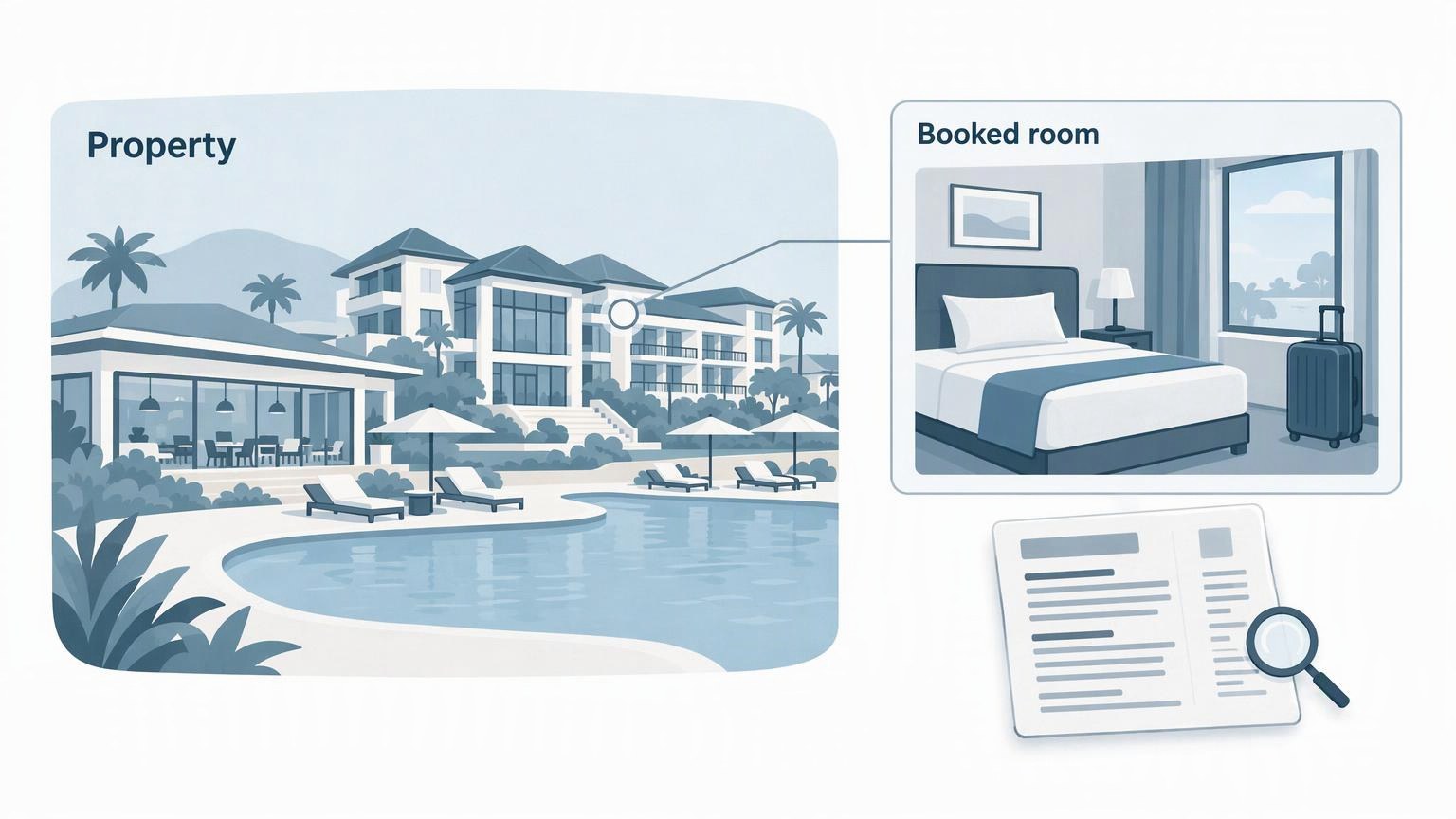
A property classification and a room description answer different questions. The first concerns the hotel under its rating scheme; the second describes the accommodation attached to your reservation. Do not let an attractive property badge stand in for the room details.
Separate what is promised from what is requested. If your trip depends on a particular bed arrangement, accessible setup, or connecting accommodation, a general four-star label is not the evidence you need. Use the written terms for the room you are considering.
The same applies to space and setting. If the listing documents a room's size, layout, or view, compare those details directly. Do not assume a higher classification guarantees more space or a better view than a lower-classified alternative.
Property facilities are not room inclusions
A resort description may mention facilities without establishing your entitlement to use them at no additional charge. For any facility that affects your choice, distinguish its existence from included access and from a separately charged service.
Photos also need context. Match room images to the category being sold rather than treating every image on the property page as a promise about your reservation. An upgraded room shown elsewhere should not justify paying more for an entry-level category.
Define the upgrade in plain language
Replace broad terms such as upscale or premium with the actual change you would buy. That might be a documented room layout, an included service, or a particular access entitlement, but it must belong to the offer you can book.
If you cannot describe the difference without referring to the stars, the premium has not yet earned its place in your budget. A lower-classified property can still be the better fit when its confirmed room meets your needs more closely.
What does the room and board price actually include?
Read the meal plan as a separate part of the offer. A four-star classification does not establish that meals, drinks, or activities are included in your rate. Even when the stay is described as all-inclusive, the booking's written inclusions are what you should compare.
Focus on the meals and services that will affect your spending. Establish which dining access is included, whether any exclusions apply, and whether a benefit belongs to the booked room category or requires an upgrade. Do not assign value to a restaurant or service merely because it appears in the property description.
Then compare the all-in stay total, including applicable taxes and mandatory fees. Keep optional spending separate so that an extra you may never purchase does not distort the accommodation comparison.
For a fuller method of aligning quotes, use our guide to comparing hotel prices without getting misled. Here, the additional test is whether the classification supports any of the differences you are being asked to pay for.
Price the benefits around your trip
An included meal has value when it replaces spending you actually expect to make. If you plan to eat away from the resort often, a more extensive board plan may be worth less to you than it is to someone staying on property throughout the trip.
Flexibility deserves its own assessment. Read the cancellation deadline, refund conditions, and payment terms rather than assuming they improve with the property's classification. A well-matched room on unsuitable booking terms can still be the wrong purchase.
When a quoted benefit is unclear, leave its value out of your calculation until it is explained. This prevents an attractive but vague description from making the more expensive stay appear better than the documented offer supports.
How would you choose between St. Lucia and Cabo quotes?
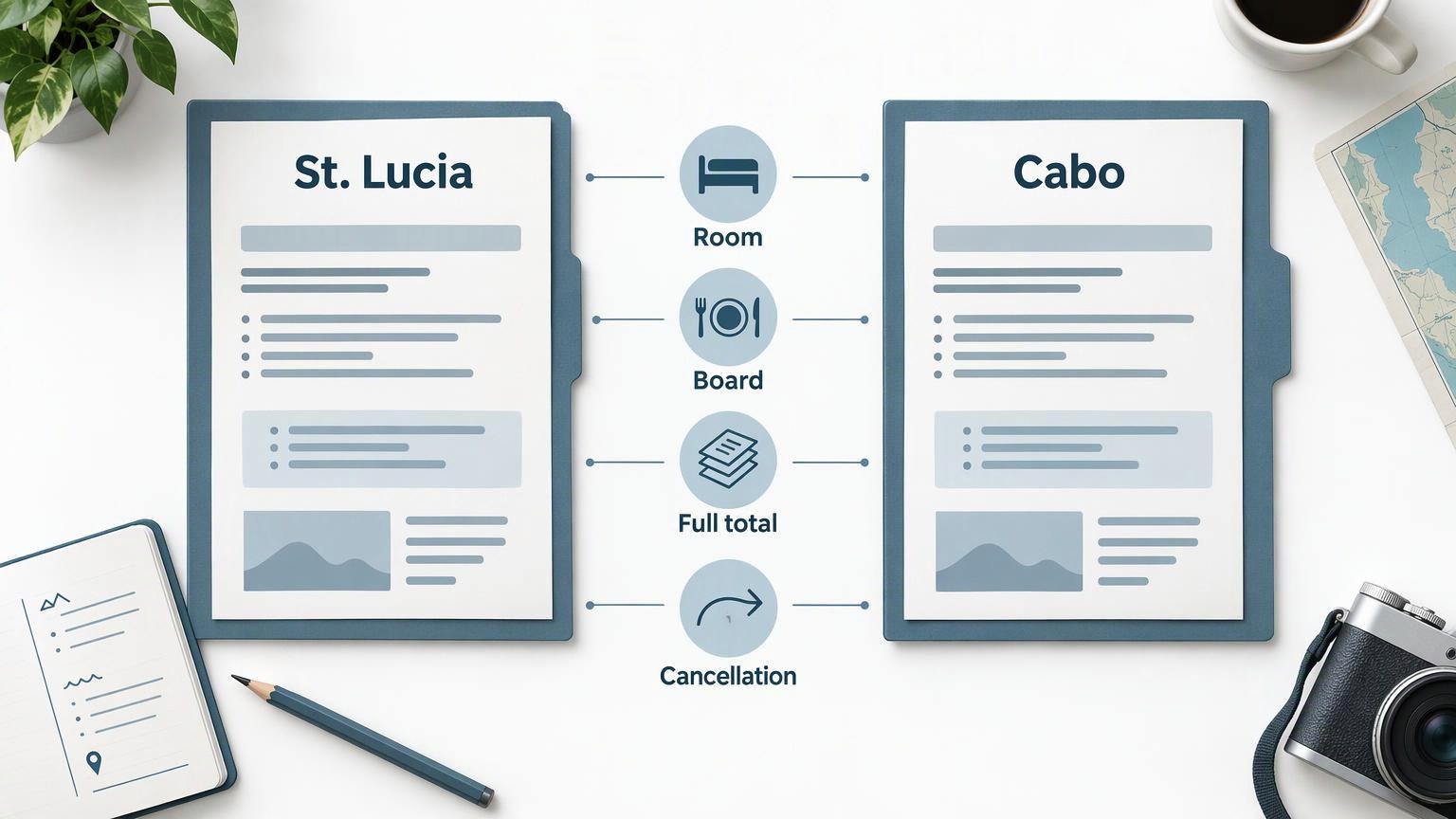
Say you are deciding between a St. Lucia all-inclusive stay and a Cabo all-inclusive stay. Both listings display four stars, and you expect to spend most of your time at the resort. Your priority is a comfortable room and a meal plan that covers the dining you intend to use.
Begin by recording the rating issuer for each property. If the issuers differ, or one is not identified, set the stars aside as a tie-breaker. Neither label establishes that the two resorts have equivalent standards.
Next, compare the exact bookable offers. Use the same dates and guest details, then read the room descriptions and board terms. The destination names do not answer whether the meals you want, the room arrangement you need, or a particular service is included.
When the higher total earns the premium
Suppose the higher quote clearly includes dining access you plan to use, while the other quote requires additional spending for that same part of your trip. Compare the accommodation totals with the relevant extra costs before deciding which is more expensive in practice.
If the higher total also buys a documented room difference you care about, that strengthens its case. The reason to pay more is the combination of useful stay terms, not the four-star symbol shared by both listings.
When the lower total is the better choice
Now suppose both offers meet your room and dining needs, but the higher quote's main distinction is an unexplained classification claim. The lower total is the stronger choice if its booking terms also fit your plans.
Change the decision if the cheaper offer requires a commitment you cannot comfortably make. For example, if your dates may change, compare the refund conditions before choosing solely on cost. That is a booking-term trade-off, not a judgment about which destination or star label is superior.
This method produces a useful conclusion even when the ratings differ: choose the stay that meets your needs at an acceptable total and level of booking risk. You do not need to declare the resorts equal to compare their suitability for your trip.
Use Travel Elite Pass to compare the stay, not just the badge
At Travel Elite Pass, we provide member-only rates revealed after login, with a focus on all-inclusive resorts in Mexico and the Caribbean. Our platform brings hotels, flights, cars, and activities into one search and includes an AI Deal Finder and an Exclusive Resort Collection.
For this decision, the useful next step is to compare St. Lucia and Cabo all-inclusive options by their documented stay terms. Keep each property's classification evidence alongside the quote rather than assuming a shared star count means equivalent accommodation.
Member pricing changes the offer you are evaluating; it does not prove a property's classification or guarantee that the quote is the lowest available. Match the room, board plan, and booking conditions before deciding whether a member rate is the better purchase.
We process bookings through our platform's checkout. Cancellation and refund terms vary by the supplying hotel or airline and are shown at checkout for each booking, so read the terms attached to your selected offer.
You can start that comparison on Travel Elite Pass. Save the selected room description, inclusions, total, and cancellation conditions before payment so your decision rests on the offer you actually chose.
Frequently Asked Questions
Is a guest review score the same as a hotel star classification?
No. A guest review score reflects submitted experiences on a particular scoring scale, while a classification applies a separate rating method to the property. Read relevant, recent comments for issues that matter to your trip, but do not convert a review score into stars or treat it as proof of your room's inclusions.
Can I compare a Four Diamond hotel directly with a four-star hotel?
Not by treating the designations as interchangeable. Preserve each scheme's name and examine its criteria before drawing conclusions about equivalent standards. You can still compare the stays by the room, board plan, total cost, and booking terms, even when the classification systems do not provide a direct match.
What if a resort has no identifiable star rating?
You can assess the resort through its documented accommodation and booking terms without assigning it a rating yourself. Decide whether the room and included services meet your needs, then examine the total and cancellation conditions. If an independently assessed standard is essential to your choice, ask for the classification details before booking.
How can I track a quote without comparing different offers by mistake?
Save the date, room category, guest details, board plan, currency, full total, and booking conditions each time you check. A changed total only gives you useful information when the underlying offer remains comparable. Keep the rating issuer in your notes too, so a different displayed star label does not silently change your comparison.
Does a member-only rate mean a lower-quality room?
Member-only pricing describes access to an offer, not a room quality classification. At Travel Elite Pass, we reveal member rates after login; assess the room category and terms attached to each rate before comparing it with another offer. Neither the member label nor the price alone establishes whether the accommodation is equivalent.
Should I pay extra for refundable terms if the hotel is four-star?
Pay extra for flexibility when the cancellation terms address a real uncertainty in your plans, not because the hotel has four stars. Compare the refund deadline, any penalties, and the extra cost of the flexible offer. The property's classification does not protect you from the conditions attached to the reservation you select.